


 By
By Your dog has had loose stools three times this week. Last night he vomited on the kitchen floor. You’ve been feeding him the same food for months, so you’re not sure what changed. Now you’re googling “best dog food for sensitive stomach” at midnight, hoping there’s a simple fix. There might be. But before you order a new bag of food, it’s worth understanding what’s actually causing the problem, because the fix depends entirely on that.
Disclaimer: This content is for informational purposes only and does not replace professional veterinary advice. Always consult a licensed veterinarian before making significant changes to your dog’s diet, especially if symptoms are severe or ongoing.
Table of Contents
Quick answer: best dog food for sensitive stomachs
The best dog food for a sensitive stomach is one that’s complete and balanced, low in fat, uses a single easily digestible protein source, and contains adequate fibre. Common triggers are high fat content, unfamiliar proteins, and low-quality ingredients. Before switching food, rule out other causes like treats, table scraps, or a medical condition. A vet visit is the right first step for any dog with ongoing digestive issues.
What counts as a sensitive stomach in dogs?
Some dogs vomit occasionally or have the odd loose stool. That’s not necessarily a sensitive stomach, that’s just being a dog.
A sensitive stomach is when digestive symptoms happen regularly, without an obvious one-off cause like eating something they shouldn’t. Signs that your dog’s digestion is consistently struggling:
- Loose stools or diarrhoea more than once or twice a week
- Vomiting that keeps coming back, not just a single incident
- Excessive gas, especially after meals
- Reduced appetite alongside any of the above
- Visible discomfort, bloating, or a hunched posture after eating
- Weight loss despite eating normally
One vomiting episode after your dog ate grass isn’t a sensitive stomach. A dog that’s regularly gassy, has soft stools most days, and occasionally vomits after meals probably is dealing with one.

Common causes of digestive problems in dogs
1. The wrong protein source
Some dogs simply don’t digest certain proteins well. Chicken and beef are the most common culprits, partly because they’re so widely used in commercial dog food. If your dog has been on a chicken-based food for years and symptoms have crept in gradually, the protein source is worth investigating.
According to the AKC, switching to a different protein, lamb, fish, or venison, for example and running a food trial is one of the first steps vets recommend for chronic digestive upset.
2. Too much fat
High-fat dog foods are harder to digest than those higher in protein or carbohydrates. Fat slows gastric emptying and puts more demand on the digestive system. If fats and oils appear in the first 4 ingredients on your dog’s current food label, the fat content may be too high for a sensitive stomach.
The crude fat percentage is listed in the Guaranteed Analysis section of every dog food label. Your vet can advise on an appropriate target range for your dog’s size, age, and activity level.
3. Not enough fibre
Fibre plays a key role in keeping digestion moving smoothly and maintaining good stool quality. According to the Merck Veterinary Manual, beet pulp provides good faecal quality in dogs without affecting other nutrient digestibility. Other useful fibre sources in dog food include inulin and psyllium.
Some dogs with soft stools or irregular digestion improve significantly just by switching to a food with a better fibre profile.
4. Treats, scraps, and sneaky eating
This is the most overlooked cause of sensitive stomach issues. A dog eating a complete and balanced food can still have ongoing digestive upset if they’re also getting:
- Table scraps (often too rich or high in fat)
- Too many treats throughout the day
- Access to cat food (higher protein and fat than dogs need)
- Opportunities to raid the bin, compost, or garden
Before blaming the dog food, audit everything else going into your dog’s mouth. If you share your home with a cat and leave their food accessible, your dog may be eating significantly more than you realise.
5. Low ingredient quality or nutritional imbalance
Commercial dog foods produced to AAFCO standards are formulated to be complete and balanced, meaning they contain at minimum the nutrients dogs require. But not all foods are equal in ingredient quality, and home-cooked or raw diets can develop nutritional gaps if they’re not carefully formulated.
If your dog is on a home-prepared diet, a veterinary nutritionist can assess whether the meals are meeting all nutritional requirements for your dog’s life stage.
6. An underlying medical condition
Persistent digestive problems aren’t always about the food. Conditions including inflammatory bowel disease, pancreatitis, intestinal parasites, food allergies, and in serious cases, gastrointestinal tumours can all present as a “sensitive stomach.” This is why a vet visit matters before a food switch.
When should you be concerned?
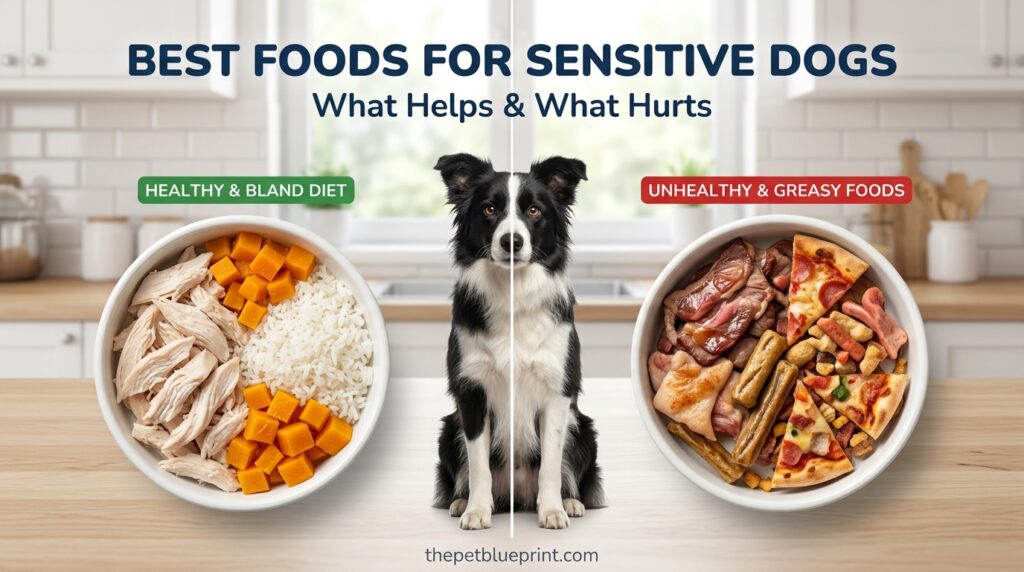
Mild, occasional digestive upset in dogs is common and usually resolves on its own. These are the signs that need veterinary attention rather than a bag of new food:
- Vomiting or diarrhoea that lasts more than 24 to 48 hours
- Blood in the stool or vomit
- Symptoms severe enough that your dog seems weak, lethargic, or in pain
- Significant weight loss over weeks
- A dog that stops eating entirely for more than 24 hours
- Bloating or a distended abdomen (this can indicate a life-threatening condition called bloat/GDV, go to an emergency vet immediately)
- Digestive symptoms alongside other changes like increased thirst, skin problems, or coat changes
- Puppies with persistent diarrhoea, they dehydrate quickly and need attention sooner
If your dog’s symptoms are severe, don’t experiment with food changes first. Get a vet assessment.
What you can do at home
- Audit everything your dog eats, not just their main food. For one week, track every treat, scrap, chew, and incidental food item. You may be surprised how much is going in outside of mealtimes.
- Try a temporary bland diet. Plain boiled chicken (no skin, no seasoning) and plain boiled white rice, in roughly a 1:2 ratio, is a standard short-term option for settling an upset stomach. Use this for 2 to 3 days, not as a long-term diet.
- Read the label on your current food. Check the first 4 ingredients, the fat percentage in the Guaranteed Analysis, the fibre sources, and whether it’s labelled “complete and balanced” for your dog’s life stage.
- Transition any new food very slowly. Start with 80 to 90% old food and 10 to 20% new food. Shift the ratio gradually over 10 days. Switching too fast is one of the most common causes of digestive upset during a food change.
- Remove all treats and scraps during any food trial. If you’re testing whether a new food helps, anything else in your dog’s diet contaminates the results.
- Keep a simple symptom diary. Note what your dog eats, when symptoms occur, and how severe they are. This information is genuinely useful at a vet appointment.

What works and what doesn’t for sensitive stomach dogs
Worth trying:
- Switching to a single-protein food your dog hasn’t eaten before
- A limited ingredient diet with fewer components to react to
- A food with a better fibre profile (beet pulp, inulin, or psyllium listed in ingredients)
- A lower-fat formula if your current food is high in fat
- Adding a vet-recommended probiotic to support gut bacteria
- A complete bland diet reset for 2 to 3 days, then a slow transition to a new food
- A prescription digestive diet if your vet recommends one
Won’t fix the underlying problem:
- Switching food without removing treats and scraps, the trial means nothing if other variables aren’t controlled
- Choosing food based on marketing claims alone (“natural,” “holistic,” “grain-free”) rather than actual ingredient and nutritional analysis
- Cycling through multiple new foods in quick succession without giving each one enough time (at least 6 to 8 weeks) to show results
- Home-cooked diets without veterinary nutritionist input, they’re nutritionally incomplete more often than owners realise
- Probiotics or supplements as the only intervention when a medical condition is the actual cause
What you should avoid
- Don’t switch food suddenly. A fast switch almost always causes digestive upset regardless of how good the new food is.
- Don’t assume grain-free means better for sensitive stomachs. The FDA has been investigating a potential link between grain-free diets and dilated cardiomyopathy in dogs since 2018. Grains aren’t automatically the problem and removing them without reason doesn’t help digestion.
- Don’t feed a puppy food designed for adults, or vice versa. Life stage matters for nutritional balance. A senior dog on puppy food, or a puppy on senior food, may develop nutritional issues that affect digestion.
- Don’t rely on forum recommendations or brand websites as your primary research source. These are opinion and marketing, not veterinary science.
- Don’t ignore persistent symptoms by just trying food after food indefinitely. If 2 or 3 well-managed food trials haven’t resolved the problem, there’s likely an underlying condition that needs diagnosing.
- Don’t give human antidiarrhoeals or antacids without veterinary guidance. Some are toxic to dogs.
When to visit a veterinarian
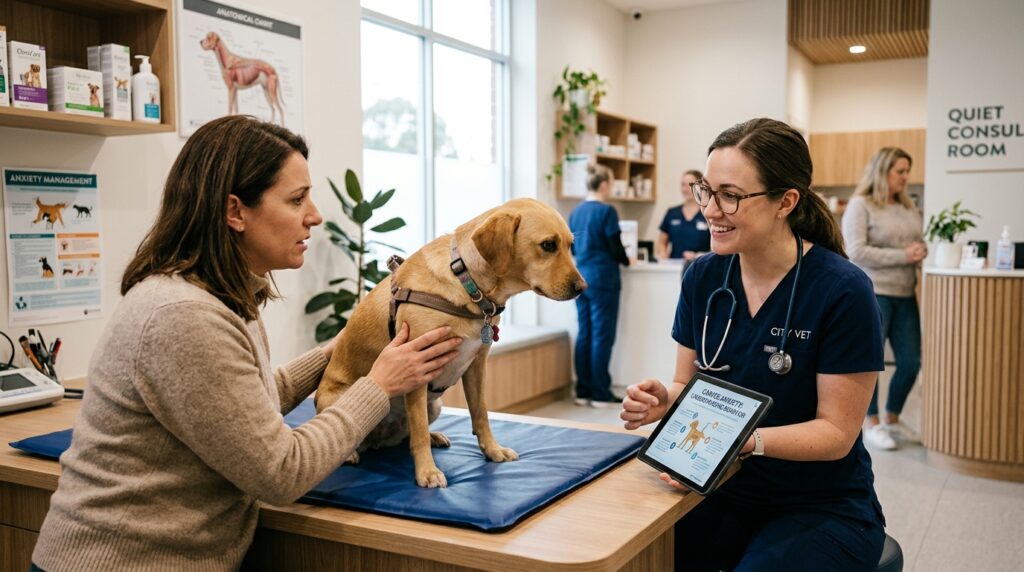
Book an appointment if:
- Digestive symptoms have been going on for more than 2 weeks
- You’ve tried a bland diet and a food transition with no improvement
- Your dog is losing weight
- Symptoms are getting worse rather than staying stable
- There’s blood in the stool or vomit at any point
- Your dog is a puppy, senior, or has an existing health condition
- You want to do a proper elimination diet, this is much more effective with vet guidance than without it
Your vet may recommend a stool sample test (to rule out parasites), blood work (to check organ function and rule out systemic causes), or a referral to a veterinary nutritionist if the case is complex.
A veterinary nutritionist (board-certified, DACVN) is a specialist in animal nutrition and the right person to design a home-cooked or elimination diet properly. This is different from a general vet and different again from a pet store employee or online nutritional advisor.
Real-life scenario
A 4-year-old Cocker Spaniel in Birmingham had been having soft stools and occasional vomiting for around 3 months. Her owner had already switched her food twice based on online recommendations and added a probiotic supplement. Nothing had improved.
The vet ran a stool sample and basic blood panel. The stool sample came back clear for parasites. Blood work showed mildly elevated liver enzymes and low B12, pointing toward poor nutrient absorption rather than a simple food sensitivity.
The diagnosis was early-stage exocrine pancreatic insufficiency (EPI), a condition where the pancreas doesn’t produce enough digestive enzymes. The fix wasn’t a new bag of food. It was enzyme supplementation added to every meal, combined with a highly digestible low-fat diet recommended by the vet.
Within 6 weeks, stools were normal and the vomiting had stopped entirely.
The lesson: 3 months of digestive symptoms that don’t respond to food changes aren’t a food problem. They’re a vet problem. Earlier investigation would have saved 3 months of unnecessary trial and error.
Frequently asked questions
What is the best dog food for sensitive stomachs and diarrhoea? Look for a food that’s complete and balanced, lower in fat, uses a digestible single protein source your dog hasn’t previously eaten, and contains a quality fibre source like beet pulp. Prescription digestive diets from your vet, such as Hill’s i/d or Royal Canin Digestive Care, are specifically formulated for this and often outperform over-the-counter options for dogs with persistent diarrhoea.
What should I feed my dog with an upset stomach? For short-term upset, plain boiled chicken and plain white rice (no seasoning, no fat) for 2 to 3 days is the standard approach. This isn’t a long-term diet, it lacks complete nutrition, but it gives the digestive system a chance to settle before transitioning back to a balanced food.
Is sensitive stomach puppy food different from adult sensitive stomach food? Yes, and it matters. Puppy food has different protein, fat, calcium, and phosphorus requirements to support growth. A sensitive stomach puppy needs a food formulated specifically for puppies, not a standard adult sensitive stomach formula. Check that the label says “complete and balanced for growth” or “for all life stages.”
How long does it take for a new dog food to work for a sensitive stomach? Give any new food at least 6 to 8 weeks before judging whether it’s working, provided symptoms aren’t severe. Digestive systems take time to adjust, and stool quality can fluctuate during the transition period. If symptoms worsen significantly within the first 2 weeks, stop and speak to your vet.
Can probiotics help a dog with a sensitive stomach? They can help as a supporting measure, particularly after illness, antibiotic treatment, or a food transition. They’re not a fix for the underlying cause on their own. If your dog has a diagnosed digestive condition, a food allergy, or a medical cause for their symptoms, a probiotic alone won’t resolve it.
Read more on thepetblueprint.com
- Thinking about adding a dog to your household? Our guide to the 12 best family dogs for real households covers which breeds tend to have fewer health complications, including digestive ones.
- If you have a new puppy working through their first weeks at home, read our full guide to potty training a puppy with puppy pads — including what normal puppy stools should look like during the early weeks.
- For more on keeping your dog’s health in order from the start, see our guide to the rabies vaccine for dogs and what every owner needs to know about their dog’s vaccine schedule.
The short version
Most dogs with sensitive stomachs improve once the actual trigger is identified, whether that’s the protein source, fat content, fibre level, or something outside the food entirely like treats and scraps. Start with a vet check if symptoms are persistent or severe, audit everything your dog eats before blaming the food, and transition any new diet slowly over 10 days. If 2 or 3 properly managed food trials don’t help, go back to the vet rather than continuing to experiment. The right food exists, finding it just takes a bit of patience and the right guidance.
Sources:
- American Kennel Club — akc.org
- Merck Veterinary Manual — merckvetmanual.com
- Association of American Feed Control Officials (AAFCO) — aafco.org
- American Veterinary Medical Association (AVMA) — avma.org
- U.S. Food and Drug Administration (FDA) — fda.gov






1 Comment