
 By
By Disclaimer: This content is for informational purposes only and does not replace professional veterinary advice. Always consult a licensed veterinarian for your dog’s health, genetics, and care needs.
Table of Contents
You’ve seen one and you can’t stop thinking about it.
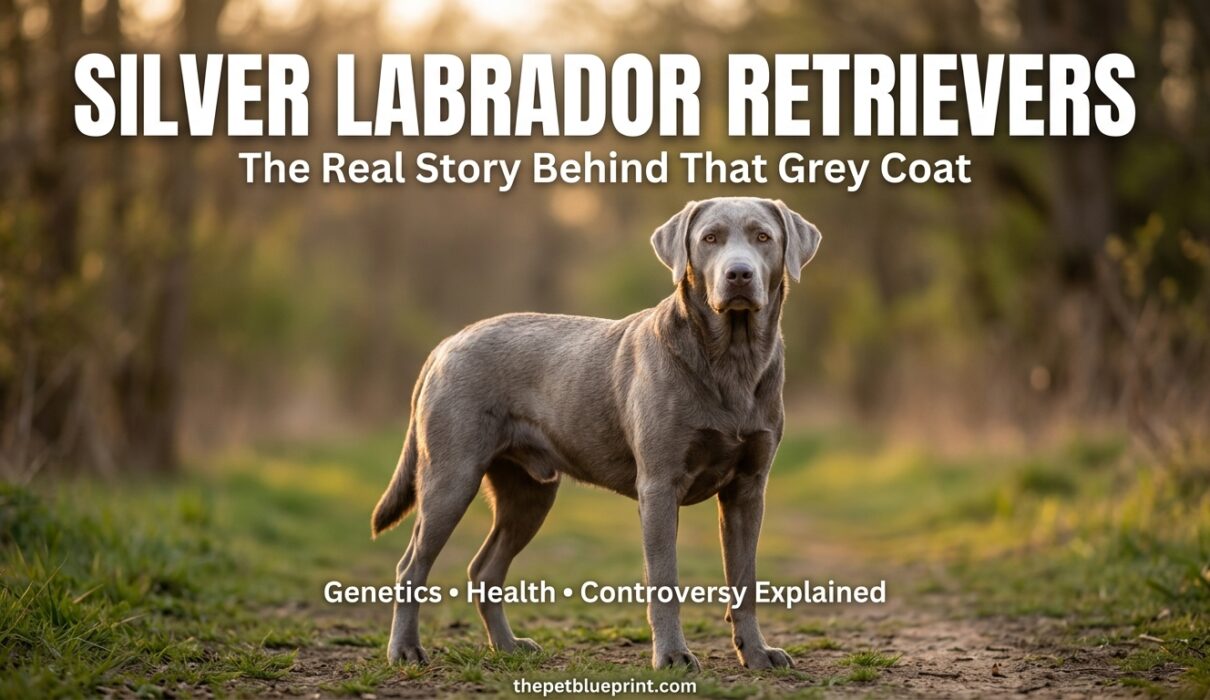
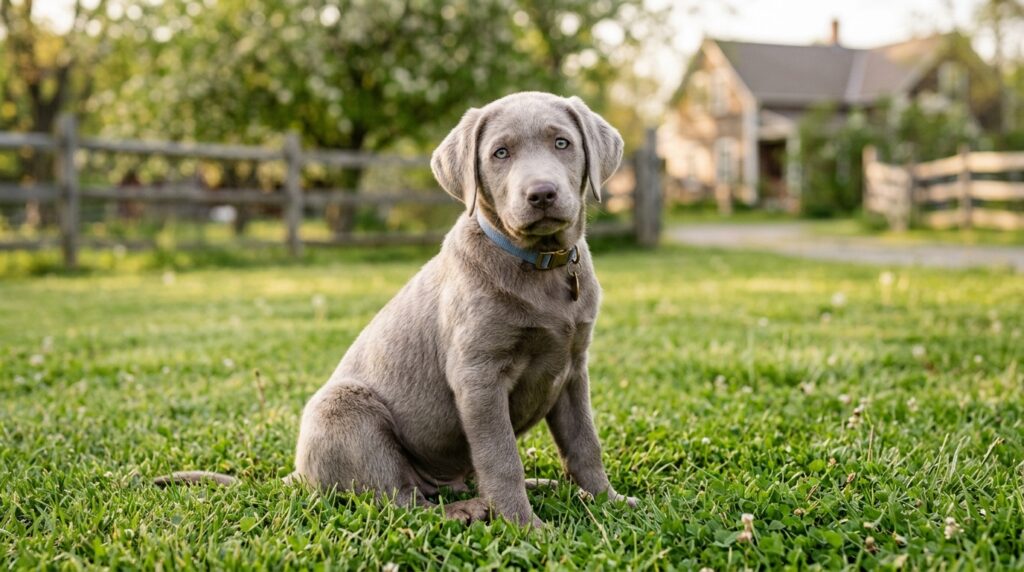
That pale, almost metallic grey coat. Those blue-grey eyes on a puppy that looks unmistakably like a Labrador. You searched “silver lab” and ended up in the middle of a decades-long argument between dog breeders, geneticists, and kennel clubs that still hasn’t been fully resolved.
Welcome to one of the most debated topics in the dog world.
Is the silver Labrador a purebred dog? A Weimaraner mix? A genetic mutation? Depending on who you ask, you’ll get a completely different answer delivered with complete confidence. This guide cuts through the noise and gives you the honest, research-backed picture.
Quick answer: what is a silver Labrador?
A silver Labrador is a Labrador Retriever with a diluted chocolate coat produced by the “dd” dilute gene, which lightens the brown pigment to a pale silvery grey. The American Kennel Club does not recognise silver as an official Labrador colour but will register silver Labs as chocolate.
Whether the dilute gene is a natural occurrence within the Labrador gene pool or was introduced through crossbreeding with another breed is genuinely disputed and, as of now, unproven either way.
The genetics: how the silver colour actually works
Every dog’s coat colour is controlled by a set of genes. For Labradors, the primary colours, black, chocolate, and yellow, are determined by two main gene loci: the B locus (brown vs. black pigment) and the E locus (whether pigment is expressed at all).
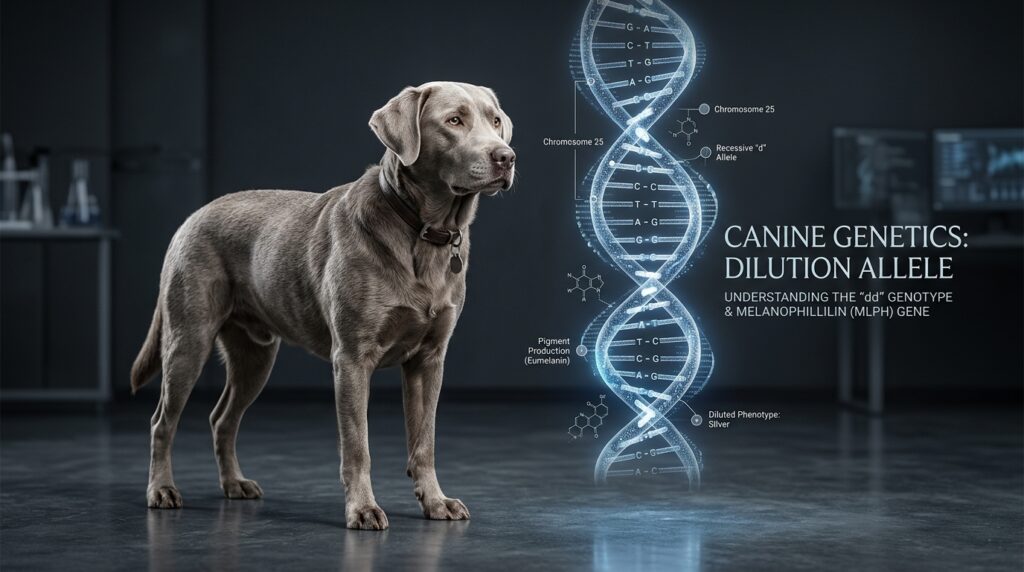
Silver Labs involve a third locus: the D locus, which controls pigment dilution.
The D gene comes in two versions: dominant D (full colour) and recessive d (dilute colour). Every dog carries two copies, one from each parent. For a silver Lab to appear, the puppy must inherit two copies of the recessive d, giving them a “dd” genotype. One copy isn’t enough, a dog with Dd will look like a normal chocolate Lab but carry the dilute gene silently.
When the dilute gene acts on chocolate (brown) pigment, the result is silver. When it acts on black pigment, the result is charcoal. When it acts on yellow pigment, the result is champagne.
So technically, there are three dilute Labrador colours:
- Silver (dilute chocolate)
- Charcoal (dilute black)
- Champagne (dilute yellow)
All three share the same underlying genetics. The coat colour is just determined by which base colour the dilute gene is acting on. (Source: Labrador Retriever Coat Colour Genetics, Wikipedia)
The controversy: where did the dilute gene come from?
This is where things get genuinely interesting and genuinely unresolved.
Theory 1: Weimaraner crossbreeding
The Weimaraner is the only known breed where the dd dilute genotype is universal. Every Weimaraner carries it. The fact that the first breeders to publicly advertise silver Labs in the 1950s were also involved with Weimaraners has fuelled decades of suspicion.
The Labrador Retriever Club, Inc., the AKC parent club for the breed, states clearly that no silver gene has ever been identified in purebred Labrador Retrievers. Their position: a crossbreeding introduced the dd gene into the Labrador gene pool, and that gene has been passed down silently through multiple generations ever since. (Source: The Labrador Retriever Club, Inc.)
Theory 2: historical breed foundation genetics
The Labrador Retriever wasn’t created in a vacuum. The breed was developed using several foundation breeds, including the St. John’s Water Dog, Newfoundland, and notably the Chesapeake Bay Retriever, which is known to carry the dd gene and can produce ash-coloured coats. Some silver Lab breeders argue the dilute gene has been in the Labrador gene pool since the breed’s foundation, just so rare that it wasn’t expressed visibly until dilute-to-dilute breedings became more common in the late 20th century.
Theory 3: genetic mutation
Spontaneous mutations do occur in dog genetics. A new mutation at the MLPH (melanophilin) gene, the gene responsible for dilution, is technically possible. This theory has the least support because it requires coincidentally producing a mutation identical to one already present in another breed.
What genetic testing shows
UC Berkeley conducted genetic testing on silver Labs against Weimaraners and found no evidence of Weimaraner DNA in the silver Lab samples tested. The AKC’s conclusion from their investigations: “there was no reason to doubt that the dogs were purebred Labrador Retrievers.”
The crossbreeding theory has lost some credibility in recent years due to these genetic findings. But the absence of detectable Weimaraner DNA doesn’t completely rule out a very distant historical crossbreeding, which is why the debate continues.
The honest answer: nobody knows for certain where the dilute gene in Labradors originated. Anyone who tells you they do is overstating what the evidence shows.
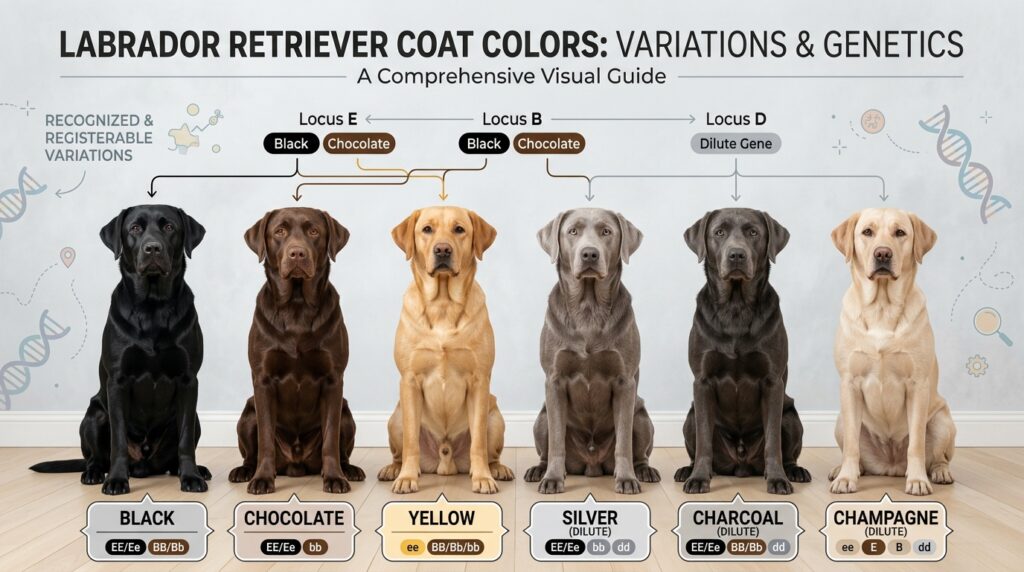
Types of silver and dilute Labradors
Silver lab (dilute chocolate)
The most well-known and searched for. Pale silvery grey coat, often with lighter eyes ranging from hazel to grey-green. Registered with the AKC as chocolate.
Charcoal lab (dilute black)
A grey Lab with a slightly darker, steel-grey appearance compared to a silver. Less common than silver but equally popular in dilute Labrador breeding circles. Registered with the AKC as black.
Grey Labrador / gray Labrador
These terms are used interchangeably with silver, particularly in the US. Same dog, different terminology depending on the owner’s preference.
Champagne lab
The dilute yellow. A pale, warm buff or cream colour, often mistaken for a very light yellow Lab. Less striking visually than silver, so less well known, but equally controversial in terms of breed purity debate.
Full grown silver lab appearance
Adult silver Labs look physically identical to standard Labs in build and structure. Males stand 22.5–24.5 inches at the shoulder and weigh 65–80 lbs. Females are 21.5–23.5 inches and 55–70 lbs. The coat is a standard Labrador double coat (short, dense, water-resistant) in that distinctive pale grey. Some dogs lighten slightly with age and sun exposure.
Silver lab health: what you actually need to know
Silver Labs share all the standard health concerns of the broader Labrador Retriever breed. The dilute gene adds one specific condition to watch for.
Standard Labrador health concerns
Hip and elbow dysplasia: Affects roughly 20% of Labradors. Particularly important to check in silver Labs because some dilute breeding programmes historically had limited gene pools. Always ask breeders for OFA (Orthopedic Foundation for Animals) hip and elbow scores on both parents.
Progressive Retinal Atrophy (PRA): A hereditary eye disease causing progressive vision loss. A DNA test exists to identify carriers. Reputable breeders will have tested their dogs.
Exercise-Induced Collapse (EIC): A genetic condition causing muscle weakness and collapse after intense exercise. Again, DNA testing is available and should be standard practice for reputable breeders.
Obesity: Labs across all colours have a genetic predisposition to overeating and weight gain. A silver Lab that’s carrying extra weight has elevated joint, heart, and metabolic risk.
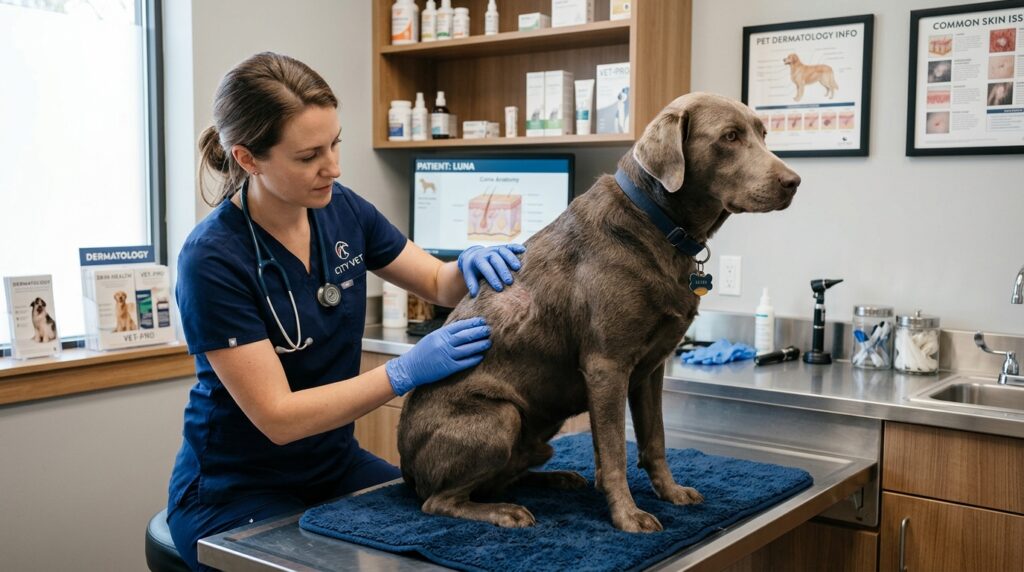
Colour Dilution Alopecia (CDA)
This is the condition specific to dogs with the dilute gene, and it deserves honest discussion.
Colour Dilution Alopecia is a skin condition associated with the dd dilute genotype across multiple breeds. It causes patchy hair loss, dry skin, and coat thinning, usually appearing between 6 months and 2 years of age. Research suggests it affects between 10–30% of silver-coated dogs, with those who are homozygous for the dilute allele (dd) at higher risk.
CDA isn’t life-threatening, but it’s chronic and there’s no cure. Management involves medicated shampoos, supplements for skin health, and regular vet monitoring. (Source: Animal Dermatology Clinic, Colour Dilution Alopecia)
The responsible approach from any reputable silver Lab breeder is to be transparent about this risk, have their breeding dogs tested for the dilute gene, and avoid inbreeding practices that amplify it.
The AKC registration situation: what it actually means
The AKC recognises three official Labrador colours: black, yellow, and chocolate. Silver is not in the breed standard.
However, the AKC will register silver Labs under chocolate. Their position is that the breed registry is based on parentage, not colour. So a silver Lab with two registered Labrador parents gets registered as a chocolate Lab.
What this means practically:
- A silver Lab can be registered with the AKC as a purebred Labrador Retriever
- A silver Lab cannot compete in AKC conformation (show) events
- A silver Lab can participate in AKC sporting, obedience, and agility events
- A silver Lab does not carry an AKC certificate that says “silver”. It says chocolate
The UK Kennel Club takes a different position: they allow registration but require silver Labs to be registered as “non-recognised.” It’s a subtle but meaningful distinction.
What silver Labs are actually like as dogs
This is what most people actually want to know, and it’s also where the controversy mostly stops mattering.
Silver Labs have the same temperament, trainability, and working ability as any other Labrador. Friendly, loyal, eager to please, highly food motivated, and excellent with families and children. Experienced trainers who have worked with silver Labs across all colours consistently report no temperament differences attributable to coat colour.
They need the same exercise as any Lab: 1–2 hours daily for adult dogs. They’re just as capable as hunting dogs, therapy dogs, search and rescue dogs, and family pets. The silver coat doesn’t change any of that.
The coat itself sheds as much as any other double-coated Lab, heavily in spring and autumn, moderately year-round. If you’re hoping the silver colour comes with lower shedding, it doesn’t.
One practical note: the silver coat can fade slightly in strong sun over years. This is normal and doesn’t affect health.
Silver lab puppy prices: what to expect
Silver Lab puppies typically cost $1,000–$2,500 from reputable breeders in the US. Some breeders charge significantly more by marketing the colour as “rare”, which is worth being sceptical of.
The silver colour is genuinely less common than black or yellow, but “rare” is a marketing word that often inflates prices beyond what the dog’s actual genetics or health testing justify. A higher price doesn’t mean better health testing or more responsible breeding.
When evaluating a silver Lab breeder, ask for:
- OFA hip and elbow scores on both parents
- DNA testing for PRA, EIC, and ideally dilute gene status
- Full breeding records and registration papers
- Transparency about CDA risk and how they manage it in their programme
- Willingness to answer questions without becoming defensive
Any breeder who dismisses health testing questions or can’t produce documentation is worth walking away from, for any breed and any colour.
When should you be concerned about a silver Lab’s health?
Watch for these signs, particularly in the first 2 years:
- Patchy hair loss or thinning coat, especially on the back and flanks (possible CDA)
- Dry, flaky, or consistently irritated skin
- Limping, difficulty getting up, or reluctance to exercise (joint issues)
- Cloudiness in the eyes or visible deterioration in vision (possible PRA)
- Collapse or weakness after intense exercise (possible EIC)
- Any significant weight gain, Labs are prone and it compounds everything else
What you can do
If you’re considering a silver Lab:
- Research the breeder’s health testing record, not just their photos or reviews
- Ask specifically about CDA, a good breeder will be open about the risk
- Verify OFA scores, you can check independently at ofa.org using the dog’s registered name
- Visit the parents if possible, temperament is strongly heritable
- Budget for health monitoring, annual vet check-ups, skin checks from year 1
If you already own a silver Lab:
- Watch the coat from 6 months onward, early CDA signs are subtle
- Keep weight under control, this is the single highest-impact health action for any Lab
- Keep up with annual vet visits, Labs benefit from regular health baselines
- Don’t over-exercise before 12–18 months, growth plates are still developing
What you should avoid
- Don’t pay a premium purely for the silver colour without verifying health testing behind it
- Don’t confuse “AKC registered” with “health tested”, registration confirms parentage, not health
- Don’t breed two dilute Labs together without veterinary genetic guidance, the practice amplifies CDA risk
- Don’t dismiss the CDA risk because your puppy seems fine at 8 weeks, it typically appears between 6 months and 2 years
When to visit a veterinarian
Book a vet appointment if you notice:
- Hair loss or skin changes in a young silver Lab (under 2 years)
- Joint stiffness or limping in any age dog
- Visible eye changes or reduced responsiveness to visual cues
- Any exercise intolerance or collapse
For silver Lab puppies, ask your vet specifically about CDA, hip and elbow monitoring, and whether genetic testing is recommended based on the puppy’s known parentage.

Real-life scenario
A family bought a silver Lab puppy at 9 weeks from a breeder who described the colour as “rare” and charged $2,800. No health testing records were provided for either parent. At 14 months, the dog developed patchy hair loss across his back, confirmed by a dermatologist as Colour Dilution Alopecia.
The condition is manageable but requires regular medicated baths, omega supplements, and vet monitoring. The family was never informed it was a known risk associated with the dilute coat.
A different family bought a silver Lab from a breeder who provided full OFA hip scores, PRA DNA test results, and a frank conversation about CDA risk. Their dog is now 4 years old with no skin issues and sound hips. The price was $1,400.
The colour was identical. The breeder’s approach made all the difference.
Frequently asked questions
Is a silver Lab a purebred Labrador? It depends on your definition. Genetically, DNA testing of silver Labs has not shown detectable Weimaraner ancestry, and the AKC registers them as purebred Labradors (under chocolate). The Labrador Retriever Club, Inc. takes the position they are not purebred. The honest answer is that the origin of the dilute gene remains unproven either way.
What is the difference between a silver lab and a charcoal lab? Both are dilute Labradors. Silver is a dilute chocolate, charcoal is a dilute black. The genetics are the same, the base colour determines which shade results from the dilute gene.
Do silver labs have more health problems than other Labs? They share all standard Lab health concerns. The additional specific risk is Colour Dilution Alopecia, which affects 10–30% of dilute-coated dogs. This is manageable but chronic. Responsible breeding and health testing significantly reduce the overall health risk profile.
Are full grown silver labs different in size from standard Labs? No. Adult silver Labs are the same size as any other Labrador, males typically 65–80 lbs, females 55–70 lbs. The coat colour has no effect on physical size or structure.
Are silver labs rare? Less common than black or yellow Labs, yes. But “rare” as a marketing term to justify premium prices is worth being sceptical of. The dilute gene pool has grown significantly in recent decades, and reputable breeders produce them regularly.
Read more on thepetblueprint.com
- German Shepherd lifespan, types, and everything first-time owners need to know: another breed with colour-related controversies and important health considerations
- What’s really inside your dog’s food: how to read a pet food label: nutrition matters particularly for Labs prone to weight gain
- Best family dogs: which breeds actually handle kids and real life: Labs in all colours feature prominently
The short version
Silver Labs are genetically dilute chocolate Labradors. The dilute gene produces the silver coat. Where that gene came from (a historical crossbreeding, foundation breed genetics, or mutation) is genuinely unresolved.
The AKC will register them as chocolate Labradors. They cannot compete in conformation shows.
As dogs, they’re every bit as capable, trainable, and family-friendly as any other Lab. The specific health risk to know about is Colour Dilution Alopecia, which affects a significant minority of dilute-coated dogs and should be disclosed by any responsible breeder.
Buy from breeders who health test. Don’t pay extra just for the colour. And enjoy the dog, because if you’ve met one, you already know the coat is genuinely striking.
Sources:
- The Labrador Retriever Club, Inc., thelabradorclub.com
- Labrador Retriever Coat Colour Genetics, Wikipedia, en.wikipedia.org
- AKC Breed Registration Standards, akc.org
- OFA Health Testing Database, ofa.org
- Animal Dermatology Clinic, Colour Dilution Alopecia, animaldermatology.com
- Canine Journal, Silver Labrador Retrievers, caninejournal.com