


 By
By Disclaimer: This content is for informational purposes only and does not replace professional veterinary advice. Always consult a licensed veterinarian for your dog’s health, nutrition, and care needs.
Table of Contents
You saw one. Now you can’t stop thinking about it.
That face. Those ears. The way a Beagador looks at you like you’re the most interesting person who has ever existed in the history of the universe.
Every article you’ve read says they’re “the perfect family dog.” And honestly? They can be. But there’s a version of this story where someone brings a Beagador home, falls completely in love, and then discovers at 2am that their dog has eaten half a sofa cushion and is now howling at a wall.
That’s not a made-up scenario. That’s Tuesday for a Beagador that didn’t get enough exercise.
This guide gives you the full picture. The things that make this mix genuinely wonderful, and the things that will genuinely test your patience. Read it before you decide, not after.
Quick answer: what is a Beagle Lab Mix?
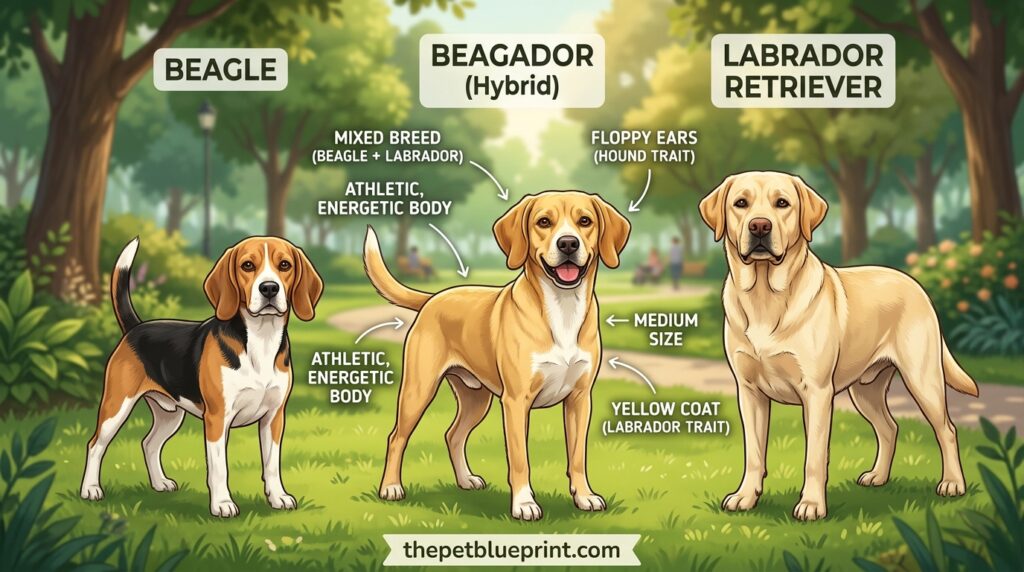
A Beagle Lab Mix (also called a Beagador, Labbe, or Labeagle) is a hybrid created by crossing a purebred Beagle with a purebred Labrador Retriever. You get the Lab’s warmth and trainability combined with the Beagle’s sharp nose and big personality.
The AKC doesn’t recognise the Beagador as a purebred, but it’s registered with several hybrid clubs including the American Canine Hybrid Club (ACHC) and the Designer Dogs Kennel Club (DDKC).
Think of it as two of America’s most beloved dogs decided to combine forces. The result is charming, energetic, occasionally maddening, and deeply lovable.
Beagador at a glance
| Other names | Labbe, Labeagle, Labbe Retriever |
| Size | Medium |
| Height | 13 to 24 inches (varies a lot) |
| Weight | 25 to 65 lbs |
| Lifespan | 10 to 15 years |
| Coat | Short, dense double coat |
| Shedding | Moderate year-round, heavier in spring and autumn |
| Energy level | High |
| Exercise needed | 60 to 90 minutes daily |
| Good with kids | Yes, with socialisation |
| Good with other pets | Generally yes |
| Separation anxiety risk | High |
| First-time owner friendly | Yes, with genuine commitment |

What does a Beagador actually look like?
Here’s the fun (and mildly frustrating) thing about mixed breeds: you order a Beagador and you might get something that looks like a compact Lab, or something that looks like a large Beagle, or something entirely its own thing. The puppy lottery is real.
Most Beagadors land somewhere in the middle. They’re medium-sized, more compact than a Lab, broader and sturdier than a Beagle. The face usually carries the Beagle’s expressive eyes and dome-shaped head, which is part of why they’re so irresistible. Those eyes communicate things. Deep, significant things. Usually “I want your dinner.”
Coat: Short, dense, and smooth with a soft undercoat. This is good news for grooming. It’s less good news for your black trousers.
Colours: Black, chocolate, or yellow from the Lab side; tricolour black/white/tan or bicolour from the Beagle side. Black lab Beagle mixes tend to produce puppies with predominantly black coats, often with white or tan markings.
Ears: Floppy, soft, and genuinely one of the best features on any dog. Also the reason ear infections are so common in this mix. Moisture gets trapped. Check them weekly.
Size reality check: The range of 13 to 24 inches and 25 to 65 lbs is genuinely wide. One Beagador owner online described their dog growing bigger than 90% of the Labs they passed on walks. If size matters for your space or lifestyle, meet the parents before you commit.
What Beagadors are actually like to live with
The genuinely wonderful parts
Beagadors are some of the most socially gifted dogs you’ll find. They love everyone. The postman. Your neighbour’s toddler. The cat across the street (although that one’s complicated). They walk into a room and somehow make everyone feel good about themselves.
With the Lab’s eagerness to please, training goes well. They’re food-motivated in a way that makes reward-based sessions genuinely productive. Most Beagadors pick up basic commands within a few weeks once you find a rhythm.
They’re also funny. Not in a trained way. In a “they just did something absurd and they know it” way. The Beagle curiosity combined with Lab enthusiasm produces a dog that treats every walk like a treasure hunt and every mealtime like a religious experience.
If you’ve ever wanted a dog that makes you laugh daily, this is your breed.
The parts nobody leads with (be honest with yourself here)
The nose runs the show. Beagles were bred to track scents across miles of terrain. That ability doesn’t disappear in the mix. A Beagador that catches something interesting on a walk will pull toward it, fixate on it, and if off-leash, disappear after it without a backward glance. Not because they don’t love you. Because they love smells more in that moment. Leash manners and a secure yard aren’t optional here. They’re non-negotiable.
They howl. The Beagle’s vocal range includes howling, baying, and what can only be described as a running commentary on the injustices of the world. Not every Beagador inherits this fully, but many do. If you’re in a flat with thin walls and a neighbour who works nights, factor this in before you decide.
They really don’t like being alone. Both parent breeds are social and struggle with isolation. A Beagador left alone for 8 hours most days will find ways to cope, and none of them involve quietly waiting by the door. Chewing, digging, howling, and creative escape attempts are the most common results. This is a dog that needs company, structure, and real mental engagement to be calm indoors.
Training hits stubborn patches. The Beagle’s independent streak occasionally overrides the Lab’s desire to please. It usually shows up around scent distractions: your dog hears “sit” and simultaneously detects a squirrel 40 metres away, and the squirrel wins. Consistent positive reinforcement handles this well, but it takes patience.

How much exercise does a Beagador actually need?
More than the puppy photos suggest.
An adult Beagador needs 60 to 90 minutes of proper exercise daily. Not a stroll. Not a 15-minute garden circuit. A brisk walk, a run, a fetch session that genuinely tires them out.
Good options:
- Two brisk walks (30 to 45 minutes each)
- Fetch sessions until they voluntarily stop (this takes a while)
- Off-leash time in a securely fenced area
- Scent tracking games, which tire a Beagador out mentally faster than physical exercise alone
- Swimming, if they’ve inherited the Lab’s love of water
Signs your Beagador is under-exercised:
- Destructive behaviour indoors (your furniture will tell you first)
- Excessive barking or howling
- Bouncing off the walls when you come home
- Digging up the garden with purpose and enthusiasm
- Restlessness at night when they should be winding down
A tired Beagador is one of the most pleasant dogs to share a sofa with. An under-exercised one is a renovation project you didn’t plan for.
Health: what to know and what to watch for
Good news first: Beagadors benefit from hybrid vigour. Mixed breeding often produces healthier, more resilient dogs than either purebred parent, which is part of why the 10 to 15 year lifespan is achievable. Many well-cared-for Beagadors reach their teens in genuinely good health.
That said, they can inherit conditions from both sides, and knowing what to look for early makes a real difference.
Hip and elbow dysplasia: More likely if your dog leans Lab in build. Joint abnormalities cause pain and eventually arthritis. OFA health testing on both parents before you buy is the single most important thing you can do. (Source: OFA Orthopedic Foundation for Animals)
Ear infections: Those beautiful floppy ears trap moisture and debris. Check them weekly, dry them after swimming or baths, and clean gently when needed. Most Beagador ear infections are preventable with 5 minutes of attention per week.
Obesity: Both Labs and Beagles have food drives that don’t come with an off switch. A Beagador with unlimited access to food will eat unlimited food, and the health consequences compound quickly. Measure portions. Every time.
Progressive Retinal Atrophy (PRA): A hereditary condition causing gradual vision loss. DNA testing exists for carriers. Ask any breeder for test results on both parents before committing. (Source: ASPCA Eye Conditions in Dogs)
Epilepsy: More common in Beagles than Labs. Manageable with medication, but lifelong. Worth knowing if a puppy’s Beagle parent has any history.
Bloat (GDV): A genuine emergency. Signs include a distended belly, unproductive retching, and restlessness after eating. Go to an emergency vet immediately if you see these. Feeding two smaller meals daily and waiting 60 minutes after eating before exercise are the main ways to reduce risk.
One more thing: if you ever notice your Beagador developing patchy hair loss, it’s worth mentioning to your vet. If a silver Lab is in the parentage somewhere (unlikely but possible), Colour Dilution Alopecia becomes a consideration. You can read more about that in our silver Labrador guide.
Grooming: actually pretty manageable
The short dense coat is one of the genuine lifestyle advantages of this mix. No professional grooming appointments every 6 weeks. No complex detangling sessions. Just regular brushing and the occasional bath.
Brushing: 2 to 3 times a week with a bristle brush or rubber grooming glove. This keeps the loose hair off your furniture rather than in a permanent layer on everything you own. During shedding season, go daily and your hoover will thank you.
Bathing: Every 6 to 8 weeks, or when they’ve found something deeply unpleasant to roll in (they will). Labs can carry a stronger wet dog smell when wet. It dissipates once they’re dry. Open a window.
Ears: Weekly check. Look for redness, odour, or dark debris. Wipe gently with a vet-recommended ear cleaner. Don’t probe deep.
Nails: Monthly trim, or whenever you can hear them clicking on hard floors. That clicking sound is not the dog being cute. That’s the sound of overgrown nails affecting their gait.
Teeth: 2 to 3 times a week with dog-specific toothpaste. Dental disease is one of the most common and most preventable problems in adult dogs, and it affects quality of life significantly. This one is worth the effort.

Feeding a Beagador: the golden rule is don’t free-feed
An active adult Beagador needs roughly 2 to 2.5 cups of quality dry food daily, split across two meals. That varies based on your dog’s actual size (which, as we’ve established, could be anywhere from 25 to 65 lbs) and activity level.
Choose a formula for medium-to-large active breeds with a named protein source as the first ingredient. Check for AAFCO compliance on the label. If decoding dog food ingredient lists sounds complicated, our dog food ingredient guide walks through it clearly.
A few Beagador-specific feeding notes:
Get a slow-feeder bowl. Both parent breeds eat at a pace best described as “urgently.” Fast eating plus a deep chest increases bloat risk. A slow-feeder bowl cuts eating speed significantly and costs about £10. Worth it.
Don’t free-feed. A Beagador with 24/7 food access will be overweight within months. They genuinely don’t have an off switch. Measure every meal.
Factor treats into the daily total. Training sessions with this breed use a lot of food rewards. If you add them on top of full meals daily, the calories stack up faster than you’d expect.

Before you bring one home: be honest with yourself
These questions matter more than the breed information:
Is someone home for a significant part of the day? If the whole household is out from 8am to 6pm, a Beagador will struggle. This isn’t the breed for that lifestyle without doggy daycare or a dog walker arranged from day one.
Is your garden escape-proof? A 5-foot fence is the minimum. Beagadors will dig under, squeeze through, and scale fences they’re determined to get past. A scent on the other side of a fence is all the motivation they need.
Can you genuinely commit to 60 to 90 minutes of exercise most days? Not on good weeks. On all weeks. The rainy Tuesday in November weeks included.
Do you have the patience for a dog that occasionally ignores you for a smell? If this will genuinely frustrate you, consider whether a more focused breed might suit you better.
If you answered yes to all of that: you’re probably going to love having a Beagador.
What you should avoid
- Don’t bring one home if long workdays and no daytime support are the norm
- Don’t let them off-leash anywhere that isn’t securely fenced, especially near roads
- Don’t free-feed. Seriously. They will not self-regulate.
- Don’t skip puppy socialisation classes. A Beagador with limited early exposure develops noise sensitivity and reactivity that’s genuinely hard to reverse
- Don’t physically correct the howling. It makes anxiety worse and the howling louder. Address the root cause instead

When to visit a veterinarian
Book a same-day or next-day appointment if your Beagador shows:
- Limping or stiffness, especially after rest
- Head shaking, ear scratching, or a smell from the ears
- Weight gain that doesn’t match their food intake (possible thyroid issues)
- Eye cloudiness or reduced reaction to visual cues
- Muscle weakness or collapse during exercise
- Distended belly and unproductive retching after meals (go immediately, this is an emergency)
Annual wellness exams matter for this breed. Hip X-rays at age 2 establish a useful baseline and catch joint changes before they become serious.
Real-life scenario
Two families. Same breed. Completely different outcomes.
Family one: couple in their 30s, two kids aged 6 and 9, garden, part-time work from home, daily walks already built into the routine. Their Beagador is now 4 years old, thriving, and has never once eaten a sofa cushion.
Family two: both partners working full-time in offices. Bought a Beagador because “medium energy, good for families” sounded manageable. Three months in, the dog had chewed through a sofa leg, howled until neighbours lodged a complaint, and developed separation anxiety serious enough to need veterinary intervention. They eventually rehomed the dog.
The breed information was identical. The lifestyle match was not.
A Beagador in the right home is genuinely one of the most rewarding dogs you can own. Funny, loyal, endlessly affectionate, and surprisingly capable. In the wrong home, it’s hard on everyone, and hardest of all on the dog.
Be honest with yourself before you decide. The dog will thank you for it.
Frequently asked questions
Is a Beagador a good first dog? Yes, if you go in prepared. Committed to daily exercise, consistent training from day one, and genuine time spent with the dog. If you want something lower-maintenance for a first experience, a Cavalier King Charles Spaniel is often a better fit.
What is the difference between a Beagador and a black lab Beagle mix? They’re the same dog. A black lab Beagle mix is a Beagador where the Lab parent happened to be black, so the puppies are more likely to carry a predominantly black coat. Everything else about the breed is identical.
Do Beagadors get along with cats? Usually yes, especially if raised with them. The Beagle scent-hunting instinct can trigger chasing behaviour with cats that bolt. A Beagador raised alongside a cat from puppyhood generally figures out the rules. Supervised introductions matter.
How much does a Beagador puppy cost? Typically $400 to $1,000 from a reputable breeder in the US. If someone is charging significantly more because the dog is “rare” or “exotic,” be sceptical. Rescue Beagadors come up regularly through Labrador and Beagle breed rescues and are considerably cheaper.
Can a Beagador live in an apartment? With enough exercise, yes. The howling is honestly the bigger challenge than the space. If your dog inherits the full Beagle vocal range, your neighbours will have opinions. Consistent training and proper exercise manage it, but go in knowing it’s a real consideration.
Read more on thepetblueprint.com
- Best family dogs: which breeds handle chaos, kids, and real life: Labs and Beagles both feature, and you can see how their combined traits compare to other family favourites
- Dog anxiety: why your dog is scared and what actually helps: Beagadors with separation anxiety need a specific approach, and this guide covers it properly
- What’s really inside your dog’s food: how to read a pet food label: especially useful for this food-driven breed where ingredient quality matters
The short version
The Beagador is one of the best dogs you can own if your lifestyle fits. Warm, funny, trainable, and genuinely devoted to their people.
It’s also a dog that howls when bored, follows its nose off a metaphorical cliff, needs real daily exercise, and falls apart when left alone too long.
Get the lifestyle match right and you’ll have a companion that makes your days better. Get it wrong and everyone suffers, especially the dog.
Take the honest look. Then decide.
Sources:
- American Kennel Club: akc.org
- OFA Orthopedic Foundation for Animals: ofa.org
- ASPCA Pet Care Costs: aspca.org
- Labrador Retriever Club, Inc.: thelabradorclub.com
- American Veterinary Medical Association: avma.org