

 By
By Written by The Pet Blueprint, Researched using guidelines from AAFCO, AVMA, and ASPCA
Disclaimer: This content is for informational purposes only and does not replace professional veterinary or legal advice. If you or someone else has been bitten, consult a licensed veterinarian for your pet’s health and seek medical attention immediately for human injuries.
What Happens When a Dog Bites And Why the Level Matters
You heard a yelp. Or a snap. Or maybe a scream.
Someone got bitten. Now you’re sitting there wondering , how serious is this, really?
Here’s the thing: not every dog bite is the same. A dog nipping your hand during play is nothing like a dog clamping down and shaking. But most people treat bites like one big scary category, and that leads to bad decisions either panicking over nothing or dangerously downplaying a real risk.
Dog bite levels give you a clear, calm framework to assess what actually happened. And once you know the level, you know exactly what to do next.
In this guide, you’ll learn every level of dog bite from Level 1 to Level 6 ,what each one means, when to worry, what to do at home, and when you absolutely need to see a vet or a lawyer.
Table of Contents
Quick Answer: What Are Dog Bite Levels?
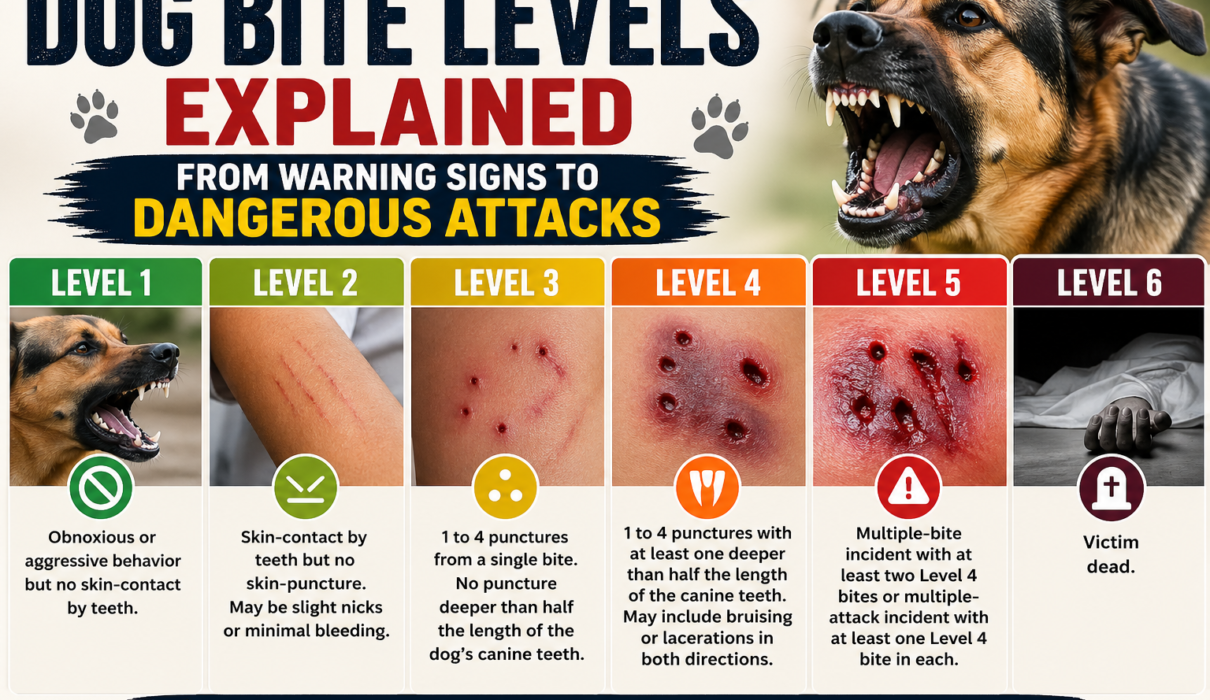
Dog bite levels are a standardized 6-point scale developed by animal behaviorist Dr. Ian Dunbar. Each level is based on the physical damage caused not how scary the dog looked or how loud it was.
The scale goes from Level 1 (no skin contact) to Level 6 (fatal attack). Most bites over 99% fall into Levels 1 and 2. Levels 3 and 4 are serious. Levels 5 and 6 are rare but life-threatening.
The 6 Levels of Dog Bites Explained
Level 1 Dog Bite : The Warning Shot
At this stage, the dog is aggressive but makes no contact with skin. Think snapping, lunging, or growling with teeth bared.
What’s actually happening: The dog is communicating. It’s saying “Back off” in the only language it has. This is almost never random , it’s usually fear, frustration, or a situation where the dog felt cornered.
Symptoms to notice:
- Snapping in the air
- Lunging without contact
- Stiff body posture, raised hackles
What it means for you: This is the easiest level to fix. Basic obedience training, socialization work, and confidence-building can resolve Level 1 behavior fairly quickly. Don’t ignore it though a dog that snaps today can bite tomorrow if nothing changes.
Level 2 Dog Bite : Teeth Make Contact, No Puncture
Here, the dog’s teeth touch the skin. There may be light scratches or minor redness, but the skin is not broken. This is what most people picture when they say “my dog nipped me.”
What’s actually happening: The dog still has bite inhibition meaning it’s holding back. This is genuinely a good sign. The dog could have bitten harder, and it chose not to.
According to the American Veterinary Medical Association (AVMA), the vast majority of reported dog bites fall into this category. (Source: AVMA Dog Bite Prevention)
What to do:
- Clean the area gently with soap and water
- Start structured training immediately use meals as reward opportunities, not free feeding
- Avoid the trigger that caused the bite (identify it first)
- Consider consulting a certified dog trainer if it happens more than once
Level 3 Dog Bite : The First Real Danger Zone
Now things get serious.
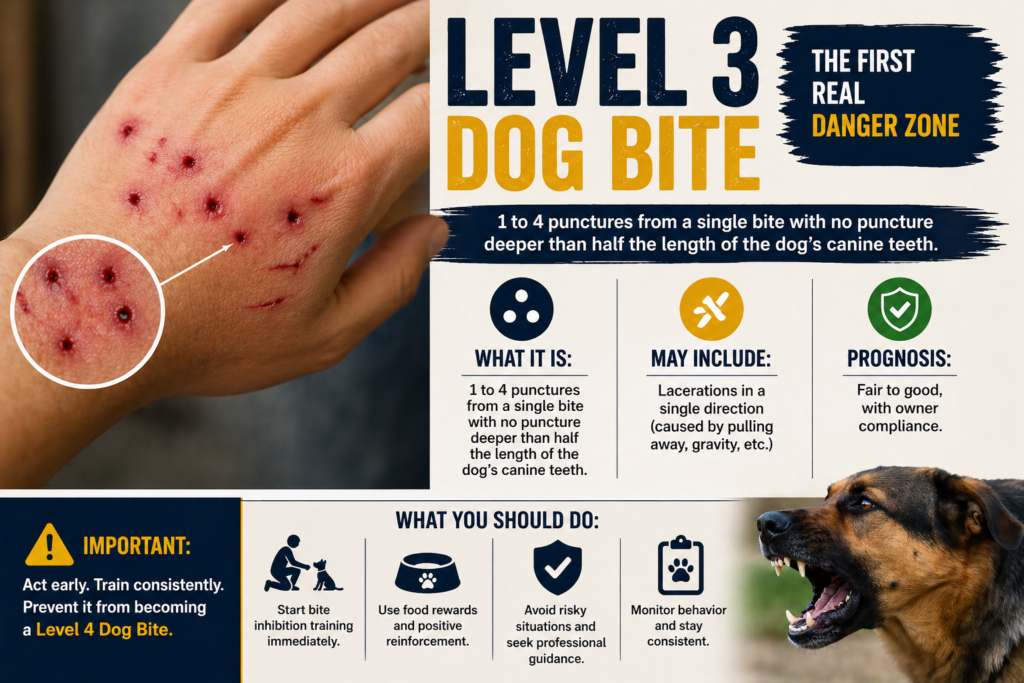
A Level 3 dog bite involves 1 to 4 puncture wounds, each shallower than half the depth of the dog’s canine tooth. There may be minor tearing in one direction if the dog pulled away.
This is a true bite. Not a warning. Not a nip. The dog made a deliberate decision to break skin.
Why it happens:
- The dog’s early warnings (Levels 1 and 2) were ignored or missed
- Poor impulse control , the dog reacted before thinking
- Situational stress: pain, fear, resource guarding, or territorial behavior
Is a Level 3 dog bite dangerous?
Yes , but it’s also your last real window to fix the problem before it becomes unmanageable. Dogs that bite at Level 3 can absolutely be rehabilitated, but it takes consistent effort, professional guidance, and zero complacency.
Prognosis: Fair to good only if the owner is proactive and consistent.
What you must do after a Level 3 bite:
- Seek medical attention for the victim immediately , dog bites can cause infections, including Pasteurella and Capnocytophaga bacteria (Source: CDC Dog Bite Information)
- Begin bite inhibition training with a professional
- Identify and eliminate the trigger situation where possible
- Document the incident with photos of the wound
Level 4 Dog Bite : High Risk, Serious Damage
This is where everything changes.
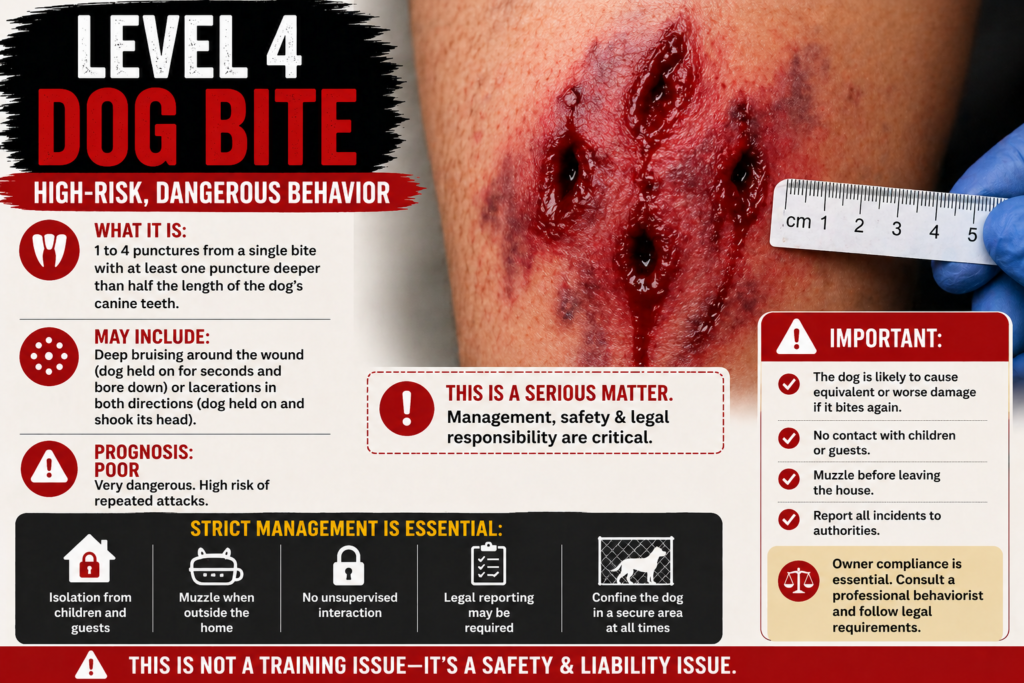
A Level 4 bite involves deep puncture wounds deeper than half the canine tooth. The dog likely held on, applied crushing pressure, and may have shaken its head. Bruising around the wound is common.
This is not an accident. This is force and intent.
A dog that bites at Level 4 has poor or no bite inhibition. That means the internal brakes the instinct most dogs have that says “stop before you do real damage” are either weak or absent.
What this means in reality:
- The dog is highly likely to bite again
- Future bites will probably be at the same level or worse
- This is a legal and safety liability in most regions
Prognosis: Poor for full rehabilitation. Management is the realistic goal.
Strict management steps:
- Muzzle training for all outdoor activity
- No unsupervised contact with children, strangers, or other animals
- Consult with a veterinary behaviorist not just a trainer
- In many regions, a Level 4 bite must be reported to animal control (Source: ASPCA Dangerous Dog Laws)
This isn’t about training tricks anymore. It’s about preventing the next incident from being worse.
Level 5 Dog Bite : Repeated Severe Attacks
A Level 5 bite means multiple attacks in one incident, with at least two Level 4-depth wounds or a pattern of repeated dangerous biting over time.
The reality: A dog at this level is a serious public safety risk. Rehabilitation is extremely unlikely to succeed, and most animal behaviorists and veterinary professionals recommend euthanasia as the ethical and responsible course of action.
This is an incredibly difficult position for any dog owner. But it’s also an honest one.
Level 6 Dog Bite : Fatal Outcome
At Level 6, the bite results in the death of the victim.
This is no longer a behavioral conversation. This is a public safety and ethical matter that involves law enforcement, legal liability, and in most jurisdictions, mandatory action regarding the dog.
If you are reading this after a Level 6 incident involving someone else’s dog, seek legal counsel immediately.
When Should You Be Concerned? Warning Signs to Watch
Regardless of the level, get medical help and take the situation seriously if you notice:
- Skin is broken or punctured in any way
- The wound is bleeding significantly or won’t stop
- Swelling, redness, or warmth develops around the bite within hours
- The victim shows signs of fever, nausea, or spreading redness (potential infection)
- The dog is unvaccinated or its vaccination status is unknown
- The bite happened on the face, neck, hands, or joints
- The victim is a child, elderly, or immunocompromised
Even a minor-looking bite can become infected quickly. Don’t wait and see.
What You Can Do at Home (Safe Steps Only)
For Level 1 and Level 2 incidents with no broken skin:
- Stay calm. Your reaction matters panicking escalates dogs.
- Remove the trigger. Give the dog space and identify what caused the reaction.
- Document what happened. Write down the time, what the dog was doing, and who was involved.
- Start training within 24 hours. Not next week. Now.
- Use meals strategically. Every meal is a training opportunity, stop free feeding.
For Level 3 and above with broken skin:
- Rinse the wound under clean running water for at least 5 minutes
- Apply gentle pressure to stop bleeding
- Cover with a clean bandage
- Seek medical attention the same day , doctors may recommend antibiotics or a tetanus booster
- Contact a professional dog trainer or veterinary behaviorist
What You Should Avoid
These are common mistakes that make everything worse:
- Don’t punish the dog physically after a bite , it increases anxiety and escalates future aggression
- Don’t dismiss Level 1 and 2 incidents as “he was just playing” , they are early warnings
- Don’t try to rehabilitate a Level 4+ dog without professional help , this is not a DIY situation
- Don’t use choke chains or punishment-based training on a dog that has already bitten , this is a proven risk factor for escalation, per research published in Applied Animal Behaviour Science
- Don’t delay medical attention for any wound that breaks the skin
When to Visit a Veterinarian or Doctor
See a doctor if:
- Skin was broken at any level
- You don’t know the dog’s vaccination history
- The bite is on a sensitive area (face, hands, feet, joints)
- The wound shows any sign of infection within 24–48 hours
See a veterinary behaviorist (not just a trainer) if:
- The dog has bitten at Level 3 or above
- The behavior is repetitive
- The dog shows no warning before biting
- You’re considering euthanasia and want a professional assessment first
A regular vet can check the dog’s health , pain, illness, and neurological issues are sometimes the hidden cause of sudden aggression.
Real-Life Scenario
A family in a suburban neighborhood noticed their 4-year-old Labrador becoming increasingly snappy around the food bowl. They brushed off the first two incidents as “he was just startled.” On the third occasion, he bit their 10-year-old’s hand when she reached toward his bowl a clean Level 3 bite, one puncture wound.
They consulted a veterinary behaviorist who identified resource guarding as the root cause. With a structured desensitization protocol, meal-based training, and clear feeding boundaries, the behavior was fully resolved within 8 weeks.
The key? They acted after the first real bite, not after the fourth.
What About a Level 3 Dog Bite Settlement Amount?
This is one of the most searched questions around dog bites and understandably so.
Here’s the honest picture:
Settlement amounts for a Level 3 dog bite vary widely depending on:
- Location and local dog bite laws (some states have strict liability, meaning the owner is automatically responsible regardless of the dog’s history)
- Medical expenses including emergency care, follow-up, and potential scarring
- Lost wages if the victim missed work
- Emotional distress as a documented factor
- Prior bite history of the dog, this significantly increases liability
In the US, the average dog bite claim cost around $64,555 in 2022, according to the Insurance Information Institute. A Level 3 bite resulting in documented injury, infection, and scarring could realistically result in settlements ranging from a few thousand dollars to significantly more, depending on the factors above.
Always consult a licensed personal injury attorney for guidance specific to your situation. This is not legal advice.
Frequently Asked Questions
Can a Level 2 dog bite get infected? Yes. Even without a puncture, if there’s any skin abrasion, bacteria can enter. Clean the area thoroughly and monitor for redness or swelling.
Is a Level 3 dog bite automatically reportable? It depends on your location. Many US states require reporting any bite that breaks skin. Check your local animal control laws or consult an attorney.
Can a dog that bit at Level 4 ever be trusted again? In rare cases with intensive professional intervention, some management is possible. However, full trust is unlikely, and the risk never fully disappears. Most veterinary behaviorists recommend strict management protocols for life.
Does a dog’s breed affect bite levels? Bite levels are based on wound severity not breed. Any breed can bite at any level. However, larger dogs tend to cause more physical damage at higher levels simply due to jaw strength.
What is the difference between a dog bite and a dog bite wound on a dog? When one dog bites another, the same level system applies. Dog-on-dog bites often look worse due to fur matting the wound. Always have a vet examine the wound, as punctures can be deceptively deep and prone to abscess.
Explore More on The Pet Blueprint
Understanding dog bite levels is just one piece of responsible dog ownership. You may also find these guides helpful:
- [How to Read Dog Body Language Before a Bite Happens]
- [Dog Aggression vs. Reactivity: What’s the Real Difference?]
- [How to Choose a Qualified Dog Trainer: What Certifications Actually Mean]
Final Thoughts
Dog bite levels aren’t just a chart. They’re a decision-making tool.
Level 1 and 2? Train now, don’t wait. Level 3? This is your turning point , act immediately. Level 4 and above? This is about safety management, not optimism.
The dogs that escalate from Level 2 to Level 4 don’t do it overnight. They do it because the early signals were missed or ignored.
You’re reading this guide, which means you’re already paying attention. That puts you ahead of most people.
Take the level seriously. Take the right steps. And if you’re unsure , ask a professional before the next bite makes the decision for you.
Sources referenced in this article:
Dr. Ian Dunbar’s Dog Bite Scale – originally published via APDT
American Veterinary Medical Association (AVMA) – avma.org
Centers for Disease Control and Prevention (CDC) – cdc.gov
ASPCA Dangerous Dog Laws – aspca.org
Insurance Information Institute – iii.org
also read : Rabies vaccination for Dogs






2 Comments