


 By
By Disclaimer: This content is for informational purposes only and does not replace professional veterinary advice. Never give your dog any medication, including Benadryl, without first consulting a licensed veterinarian. Dosage information in this article is based on published veterinary guidelines and is provided for educational purposes only.
Table of Contents
Your dog is scratching. You’ve got Benadryl in the cabinet. Now what?
It’s 9pm. Your dog has been itching for two hours. There’s a box of Benadryl on the shelf and you’re wondering if it’s safe to just give them a tablet.
Here’s the honest answer: probably yes, but there are things you need to check first. The wrong formula can be toxic. The wrong dose causes problems. And for some conditions, Benadryl does almost nothing.
This guide covers what Benadryl actually does for dogs, what the safe dosage looks like by weight, and when you should skip it entirely and call a vet.
Quick answer: can dogs have Benadryl?
Yes. Benadryl (diphenhydramine) is one of the few human medications that vets regularly recommend for dogs. It’s used for mild allergic reactions, motion sickness, and occasional itching from environmental allergens.
Two things to check before you give it: make sure the formula contains only diphenhydramine as the active ingredient, and confirm your dog doesn’t have a health condition that makes antihistamines risky. More on both below.
What is Benadryl and how does it work in dogs?
Benadryl is an antihistamine. It works by blocking H-1 receptors, which are the receptors that respond to histamine — the chemical your dog’s body releases during an allergic reaction.
It also has a mild sedative effect, which is why people sometimes try it for anxiety. And it can reduce nausea by suppressing the vomiting centre in the brain and dampening the vestibular system’s response to motion.
According to the Merck Veterinary Manual, diphenhydramine is a commonly used antihistamine in veterinary medicine, with a wide safety margin when dosed correctly. (Source: Merck Veterinary Manual)
What does Benadryl actually treat in dogs?
Mild allergic reactions
This is where Benadryl is most useful. Insect stings, mild vaccine reactions, contact with a plant or allergen — Benadryl can reduce swelling, hives, and itching in these situations.
One number worth knowing: research suggests diphenhydramine is only effective in around 7% of chronic dog allergy cases. So if your dog has ongoing seasonal allergies, Benadryl probably won’t solve it. It’s a short-term tool, not a long-term allergy plan. (Source: PetMD Veterinary Review)
Motion sickness
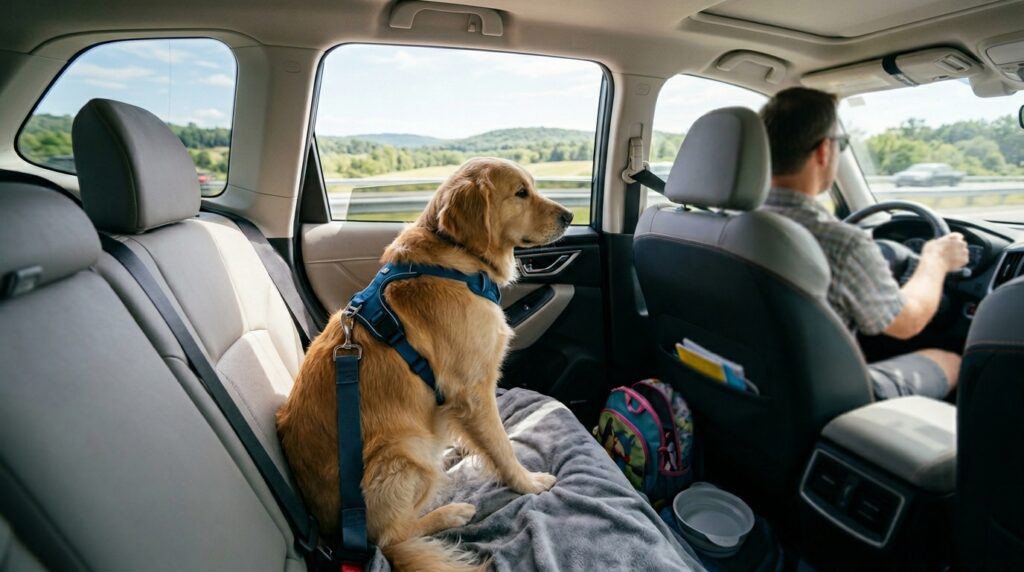
Benadryl is reasonably effective for dogs that get nauseous in the car. It won’t eliminate motion sickness, but it can reduce vomiting and the distress that goes with it. If car sickness is a consistent problem, ask your vet about Cerenia (maropitant), it’s a prescription medication specifically designed for motion sickness in dogs and works significantly better.
Itching from environmental allergens
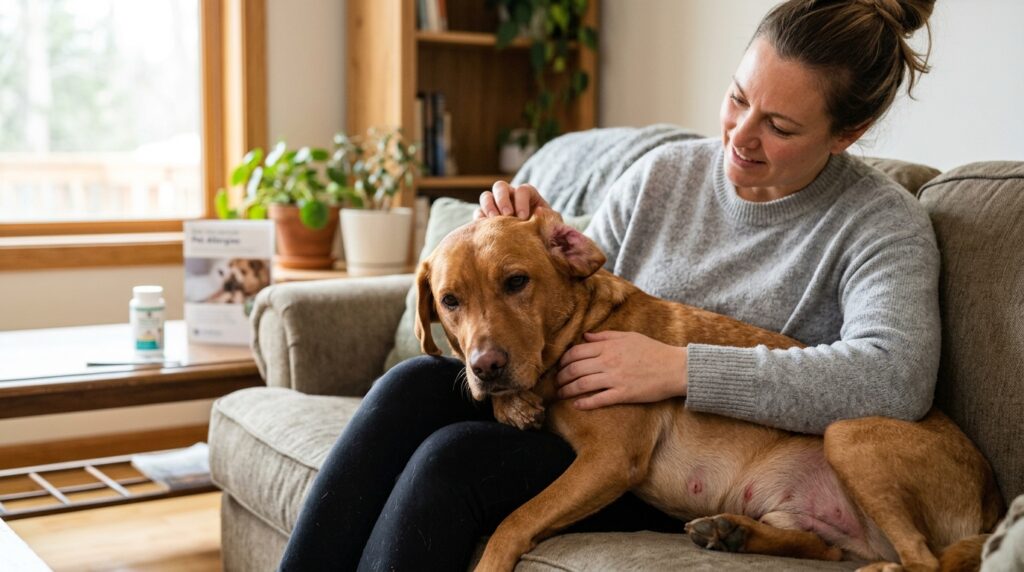
Pollen, mold, dust mite. Benadryl can take the edge off mild itching from these triggers. For anything beyond mild or occasional itching, a vet visit is the right move. Skin conditions in dogs often need more targeted treatment.
Anxiety: the honest answer
Benadryl makes some dogs slightly drowsy. It does not reduce anxiety. There’s a difference between a sedated dog and a calm one. Benadryl doesn’t address the underlying anxiety at all, it just makes some dogs sleepy, and not all dogs respond that way. Some actually become more agitated on it.
If your dog has genuine anxiety around fireworks, thunderstorms, or travel, talk to your vet. Prescription options like fluoxetine or behavioural modification programs actually work. Benadryl is not the answer here.
Is Benadryl safe for dogs?
Generally yes, with a few important exceptions.
Don’t give Benadryl to dogs with:
- Cardiovascular disease or heart conditions
- Glaucoma
- Liver disease
- Seizure disorders
- Difficulty urinating (urinary retention)
- Lung conditions
- Pregnancy
Also check for drug interactions if your dog takes any regular medication. Benadryl interacts with monoamine oxidase inhibitors and some antifungal medications, among others. When in doubt, call your vet before giving it.
One more thing: check the label every single time. Some Benadryl formulas contain additional active ingredients, decongestants, pain relievers, or the artificial sweetener xylitol in children’s liquid versions. Xylitol is seriously toxic to dogs. You want plain diphenhydramine only. Nothing else.
Benadryl dosage for dogs: how much to give
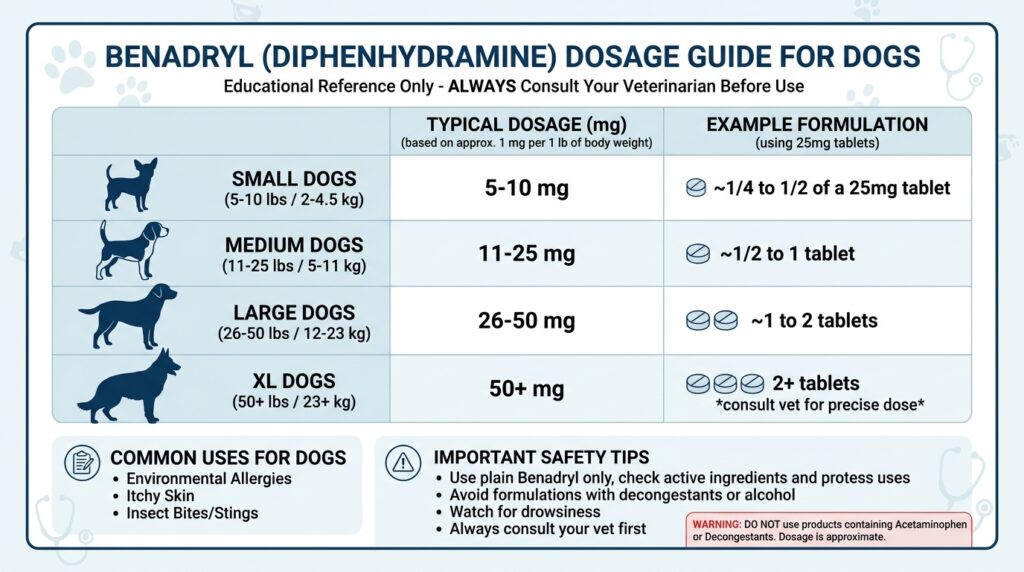
The standard dosage from the Merck Veterinary Manual is 1 mg of diphenhydramine per pound of body weight, given 2 to 3 times daily (every 8 to 12 hours).
So a 25 lb dog gets 25 mg. A 50 lb dog gets 50 mg. Standard Benadryl tablets come in 25 mg and 50 mg doses.
Benadryl tablet dosage by weight
| Dog’s weight | Benadryl dose (tablets) | Frequency |
|---|---|---|
| 10 lbs | 10 mg | Every 8–12 hours |
| 20 lbs | 20 mg | Every 8–12 hours |
| 25 lbs | 25 mg (one 25 mg tablet) | Every 8–12 hours |
| 30 lbs | 30 mg | Every 8–12 hours |
| 40 lbs | 40 mg | Every 8–12 hours |
| 50 lbs | 50 mg (one 50 mg tablet) | Every 8–12 hours |
| 60 lbs | 60 mg | Every 8–12 hours |
| 75 lbs | 75 mg | Every 8–12 hours |
| 90 lbs | 90 mg | Every 8–12 hours |
| 100 lbs | 100 mg | Every 8–12 hours |
How much Benadryl to give a 50 lb dog
A 50 lb dog gets 50 mg of diphenhydramine, one standard 50 mg Benadryl tablet. Given every 8 to 12 hours, that’s 2 to 3 doses in a 24-hour period.
Liquid Benadryl dosage for dogs
Children’s liquid Benadryl contains 12.5 mg per 5 ml (which is 2.5 mg/ml). To calculate the dose for liquid: divide your dog’s weight in pounds by 2.5.
A 10 lb dog gets 4 ml. A 20 lb dog gets 8 ml. For very small dogs under 10 lbs, liquid or children’s chewable tablets are easier to dose accurately than splitting an adult tablet.
Important: some children’s liquid Benadryl contains xylitol. Check the ingredients list before using any liquid formula on your dog.
Benadryl for cats: a quick note
Cat owners sometimes ask the same question. Benadryl can be used in cats too, but the dosage is different and cats are more sensitive to many medications than dogs. The general guideline is 1 mg/kg, but this really needs to come from your vet for the specific cat and situation. Don’t use the dog dosage chart above for a cat.What about children’s Benadryl dosage by weight for dogs?
If you’re using children’s Benadryl for a small dog, the same 1 mg per pound rule applies, you’re just working with a lower concentration.
Children’s chewable tablets are 12.5 mg each. A dog under 10 lbs can take half a tablet. Children’s liquid is 2.5 mg/ml, so use the formula above (weight in lbs divided by 2.5 = ml to give).
For very small dogs under 5 lbs, ask your vet for exact guidance. The margin for error is smaller at low body weights.
Side effects of Benadryl in dogs
At normal doses, the most common side effect is drowsiness. Some dogs also get dry mouth or strain slightly when urinating.
Less commonly you might see:
- Decreased appetite
- Mild vomiting or diarrhea
- Slightly increased heart rate
Some dogs react the opposite way and become hyperactive or agitated instead of sleepy. If that happens, note it and tell your vet. Benadryl probably isn’t the right choice for that dog going forward.
Signs of a Benadryl overdoseOverdose is unlikely at correct doses, but if your dog got into the medication, watch for:
- Severe sedation or, conversely, extreme agitation
- Disorientation
- Rapid or irregular heartbeat
- Seizures
- Difficulty breathing
- Collapse
If you see any of these, don’t wait. Call your vet or contact the ASPCA Animal Poison Control Center at (888) 426-4435 immediately. (Source: ASPCA Animal Poison Control)
When should you be worried?
Go to a vet rather than reaching for Benadryl if:
- Your dog’s face is swelling, especially around the eyes or muzzle
- Your dog is having difficulty breathing
- The allergic reaction came on suddenly and is progressing fast
- Your dog has been stung multiple times
- Your dog is vomiting repeatedly, not just nauseous
- The itching or symptoms have been going on for more than a few days
Anaphylaxis in dogs is a medical emergency. Facial swelling and breathing difficulty are the two clearest signs. Benadryl won’t be enough, your dog needs injectable treatment and vet monitoring.
What you can do at home
If your vet has confirmed Benadryl is appropriate for your dog’s situation:
- Check the label: active ingredient should say diphenhydramine only. No decongestants, no pain relievers, no xylitol.
- Calculate the dose by weight: 1 mg per pound, 2 to 3 times daily.
- Use the right form: tablets for medium and large dogs, liquid or children’s chewables for dogs under 15 lbs.
- Give with food if your dog has a sensitive stomach.
- Monitor for the first hour: especially if it’s your dog’s first time taking it.
- Don’t exceed 3 doses in 24 hours regardless of your dog’s size.
If your dog won’t take tablets, putting the pill inside a small piece of soft food works well for most dogs.
What you should avoid
- Don’t use any Benadryl formula that contains more than one active ingredient
- Don’t give Benadryl to a dog with heart, liver, kidney, or seizure conditions without explicit vet approval
- Don’t use Benadryl as a long-term solution for allergies, it addresses symptoms, not causes
- Don’t use the dog dosage for cats
- Don’t assume Benadryl will calm an anxious dog, it won’t, and in some dogs it makes things worse
- Don’t mix Benadryl with other sedatives or medications without checking with your vet first
When to visit a veterinarian
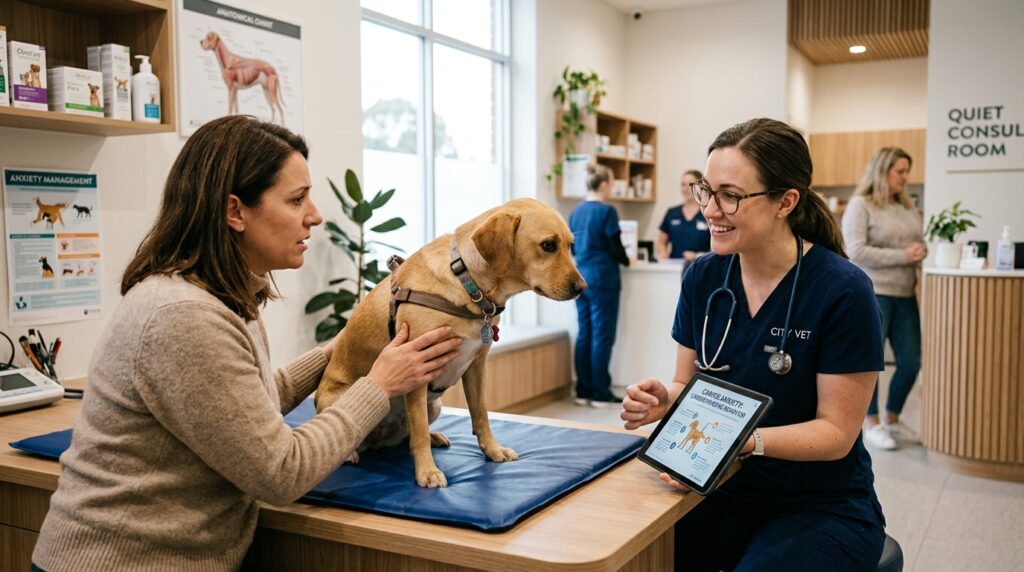
See your vet if:
- Your dog’s allergic symptoms don’t improve within 24 hours of starting Benadryl
- The same allergic reaction keeps coming back (recurring reactions need diagnosis, not ongoing antihistamines)
- You want a proper treatment plan for seasonal or environmental allergies
- Your dog has anxiety that’s affecting their daily quality of life
- You’re unsure whether the symptoms are allergies or something else entirely
- Your dog has any existing health condition and you want to confirm Benadryl is safe for them specifically
For chronic allergies, ask your vet about prescription antihistamines like hydroxyzine, or newer options like Cytopoint or Apoquel, which are specifically designed for dogs and work significantly better than diphenhydramine for ongoing allergy management.
For dog anxiety medication, prescription options including fluoxetine (Reconcile), clomipramine (Clomicalm), or situational medications like trazodone are far more effective than Benadryl. Your vet can help you decide what fits your dog’s situation.
For dog travel sickness medicine, ask specifically about Cerenia. It’s prescription-only but is the most effective option currently available for dogs and works within a few hours of the first dose.
Real-life scenario
A Labrador mix was stung by a bee in the garden. Within about 20 minutes, mild hives appeared around the sting site. The owner called their vet, described the symptoms, confirmed no facial swelling and normal breathing, and was advised to give 50 mg of plain diphenhydramine (one 50 mg tablet). The dog weighed 52 lbs.
The hives reduced within 90 minutes. The owner monitored for 3 hours and saw no further symptoms. No vet visit needed that evening.
Two things made that a good outcome: the owner called first, and they had plain diphenhydramine tablets (not a multi-symptom formula). That’s the template for using Benadryl correctly at home.
Frequently asked questions
How long does Benadryl take to work in dogs? About 1 to 2 hours from when they take it. Peak effect is usually within that window, and the effects last roughly 8 hours.
Does Benadryl make dogs sleepy? Yes, in most dogs. Drowsiness is the most common side effect. A small number of dogs have the opposite reaction and become hyperactive or agitated. If that happens, Benadryl probably isn’t a good fit for your dog.
Is Benadryl or Zyrtec better for dogs? Research suggests cetirizine (Zyrtec) is slightly more effective for seasonal allergies in dogs, around 15% effectiveness compared to Benadryl’s 7%. But neither works particularly well for chronic allergies. Prescription options like Cytopoint or Apoquel are more effective for dogs with significant ongoing symptoms. Ask your vet.
Can I give my dog children’s Benadryl? Yes, provided it contains only diphenhydramine and no xylitol. Check the ingredients every time — formulas vary by product line.
How much Benadryl can I give my dog calculator approach? The simple formula: your dog’s weight in pounds equals the dose in milligrams. A 30 lb dog gets 30 mg. A 50 lb dog gets 50 mg. For liquid, divide the weight by 2.5 to get ml.
Read more on thepetblueprint.com
- [Dog allergies: how to find the trigger and actually fix it — thepetblueprint.com]
- [Best family dogs: which breeds handle chaos, kids, and real life — thepetblueprint.com]
The short version
Benadryl is safe for most dogs at 1 mg per pound, 2 to 3 times daily. Use plain diphenhydramine only. Check for xylitol in any liquid formula. Skip it if your dog has heart, liver, kidney, or seizure conditions.
It works well for mild allergic reactions and motion sickness. It doesn’t work well for chronic allergies, and it doesn’t reliably help anxiety.
Call your vet if symptoms are severe, progressing fast, or don’t respond within 24 hours. That’s the whole picture.
Sources:
- Merck Veterinary Manual — merckvetmanual.com
- ASPCA Animal Poison Control Center — aspca.org
- American Kennel Club — akc.org
- PetMD Veterinary Review — petmd.com





1 Comment