


 By
By Disclaimer: This content is for informational purposes only and does not replace professional veterinary advice. Always consult a licensed veterinarian before introducing new foods to your dog’s diet, especially if your dog has diabetes, kidney disease, or is on a prescription diet.
Table of Contents
You’re holding a blueberry. Your dog is staring at it like it’s made of gold.
You’re wondering: is this actually safe, or am I about to accidentally poison my dog with something that sounds healthy?
Good news. Blueberries are one of the genuinely safe human foods dogs can eat. And unlike a lot of “superfoods” that get hyped for pets, blueberries actually have real research behind their benefits, not just marketing copy.
This guide covers what blueberries actually do for dogs, how many to give, what to avoid, and why your diabetic dog should probably skip them entirely.
Quick answer: can dogs eat blueberries?
Yes. Fresh or frozen plain blueberries are safe for most dogs and genuinely nutritious in appropriate amounts.
The 10% rule applies here: treats of any kind should stay under 10% of your dog’s daily calorie intake. For blueberries specifically, that works out to a small handful depending on your dog’s size, more on the exact numbers below.
Are blueberries actually good for dogs? What the research says
Blueberries aren’t just safe, they have more evidence behind their benefits than almost any other fruit recommended for dogs.
Antioxidant protection
Blueberries are rich in anthocyanins, the compounds that give them their deep blue colour. These are natural antioxidants that protect cells from oxidative damage. In dogs, this matters most for joint health, immune function, and long-term disease prevention.
A 2006 study from the University of Alaska Fairbanks found that sled dogs fed blueberries had significantly higher antioxidant capacity in their blood after intense exercise compared to those without blueberries in their diet. For active dogs, this is a meaningful finding. (Source: Journal of Nutritional Biochemistry, 2006)
Cognitive support in senior dogs
A 2017 study published in the Journal of Nutritional Science fed senior Beagles a blueberry-enriched diet for 75 days. The dogs performed better on memory tasks compared to a control group. The researchers linked this to antioxidant-related gene changes that appear to protect brain cells during ageing. (Source: Journal of Nutritional Science, 2017)
If you have an older dog showing early signs of cognitive decline, confusion, disrupted sleep, getting lost in familiar spaces, blueberries aren’t a cure, but adding them to the diet is a low-risk, evidence-supported step worth discussing with your vet.
Digestibility and palatability
A 2025 study from the Universitat Autònoma de Barcelona tested wet diets for Beagles with and without blueberries. Dogs consistently chose the blueberry diet when given a choice. More importantly, adding blueberries didn’t negatively affect digestion, nutrient absorption was identical to the control group. The blueberry dogs also showed lower creatine kinase levels, an enzyme that rises with heat stress, suggesting possible heat-stress protection. ([Source: Universitat Autònoma de Barcelona, 2025])
Nutritional profile
According to the USDA, 100 grams of blueberries contain:
- 57 calories
- 2.4 grams of dietary fibre
- 9.7 mg of vitamin C
- 19.3 µg of vitamin K
- 77 mg of potassium
For a small treat, that’s a solid nutritional contribution. Low in calories, high in fibre, and with genuine antioxidant value. (Source: USDA FoodData Central)
How many blueberries can a dog eat?
Stick to the 10% treat rule and these size-based guidelines:
| Dog size | Daily blueberry limit |
|---|---|
| Small dogs under 20 lbs | 2–3 blueberries |
| Medium dogs 20–50 lbs | 4–6 blueberries |
| Large dogs over 50 lbs | up to 10 blueberries |
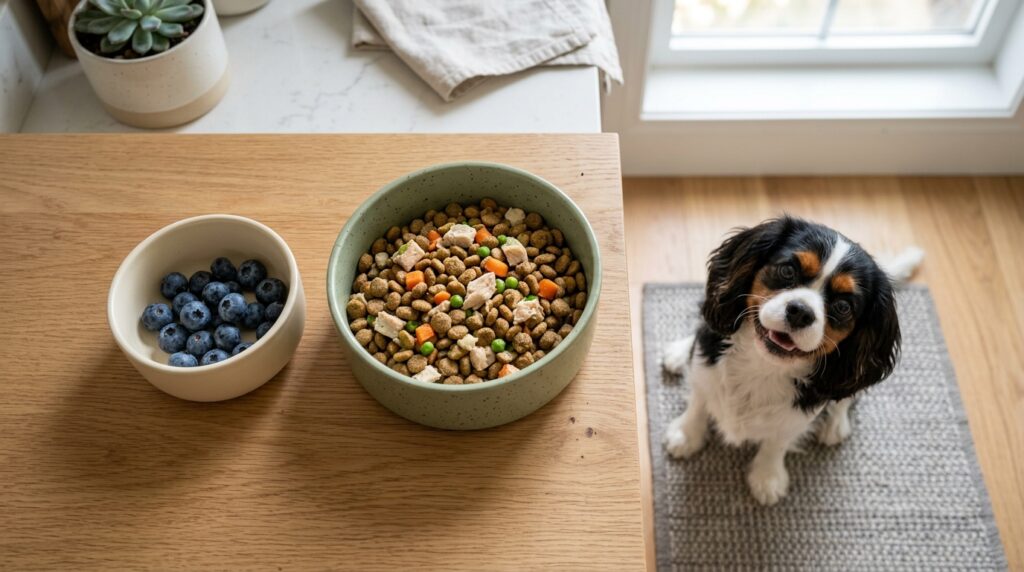
Start with fewer than this if your dog has never had blueberries before. The fibre content can cause loose stools when introduced too quickly give 2–3 berries for the first few days, then build up if digestion is fine.
Are blueberries bad for dogs in any situation?
For most healthy adult dogs, no. But there are specific situations where blueberries aren’t a good idea.
Dogs with diabetes
Blueberries contain natural sugar. Healthy dogs can handle this in small amounts. Diabetic dogs have compromised glucose regulation and shouldn’t have high-sugar fruits added to their diet without explicit vet guidance.
Dogs with kidney disease
Potassium and phosphorus levels matter in kidney disease management. Blueberries contain both. If your dog is on a renal diet, don’t add any fruit without checking with your vet first.
Dogs with food sensitivities or allergies
Blueberries are not a common allergen, but individual dogs can react to almost anything. If your dog has a known history of food sensitivities perhaps you’ve already been through the process of identifying food allergy triggers, introduce blueberries as a single new food and monitor for 48 hours.
Small dogs eating too fast
Blueberries are small and round a choking hazard for tiny dogs or dogs that inhale food without chewing. Cut them in half or mash them for dogs under 10 lbs or any dog known to eat quickly.
When should you be concerned?
Call your vet if your dog ate blueberries and shows:
- Vomiting more than once or twice
- Diarrhea that lasts more than 24 hours
- Swollen face or signs of an allergic reaction (hives, itching, difficulty breathing)
- Significant lethargy after eating them
Also call if your dog ate a blueberry product that contained xylitol (a sweetener found in some jams, yogurts, and baked goods). Xylitol is severely toxic to dogs, even small amounts cause dangerous blood sugar drops and can cause liver failure. If xylitol was involved, treat it as an emergency and call the ASPCA Animal Poison Control at (888) 426-4435 immediately.

How to safely feed blueberries to your dog
Fresh
The best option. Wash thoroughly under cold water to remove pesticide residue and surface dirt. Serve whole for medium and large dogs, halved for small dogs. That’s it.
Frozen
Just as nutritious as fresh. Many dogs prefer the texture and crunch of frozen blueberries, especially in summer. Keep a bag in the freezer and use them as training rewards or afternoon treats. Check that they’re plain, no added sugar, syrup, or preservatives.
Mashed or puréed
Mix a small amount into your dog’s regular food for a nutritional boost. Useful for dogs that need encouragement to eat or senior dogs that appreciate softer textures.
A simple frozen treat: blend blueberries with a small amount of plain xylitol-free yogurt and stuff into a Kong toy. Freeze for a couple of hours. This keeps a dog occupied for 15–20 minutes and combines the antioxidant benefits of blueberries with the probiotic value of plain yogurt.
As a training reward
Blueberries are low in calories and the right size for repeated training rewards. For a 30-minute training session, 4–5 blueberries used as occasional high-value rewards fit within daily portion guidelines for most dogs.

What you should avoid
This is where it gets important. Several blueberry-based products that seem harmless are actually problematic.
Blueberry muffins: High in sugar, fat, and calories. Many contain nutmeg (toxic to dogs) or chocolate. Even homemade blueberry muffins should stay away from dogs, the batter alone often contains enough sugar and fat to cause digestive upset.
Blueberry jam or spread: Extremely high in sugar. Many reduced-sugar versions contain xylitol, which is fatal to dogs. Never give jam to your dog, and check labels carefully if your dog has gotten into anything sweetened.
Blueberry yogurt: Store-bought flavoured yogurts often contain added sugar, artificial sweeteners, and sometimes xylitol. If you want to combine blueberries and yogurt, use plain, unsweetened, xylitol-free yogurt that you’ve checked the label on yourself.
Blueberry-flavoured treats with unknown ingredients: Some commercial treats list “blueberry flavour” without containing actual blueberries. Check ingredient lists “natural flavouring” can mean very little.
Trail mix containing blueberries: Trail mixes almost always contain raisins, chocolate chips, or macadamia nuts alongside dried fruit. All three are toxic to dogs. Never share trail mix with your dog even if it contains blueberries.
Dried blueberries from stores: The drying process concentrates sugars significantly. Most commercial dried blueberries also contain added sweeteners or preservatives. If you want to give dried blueberries, dehydrate them yourself at home with no additives, and give a smaller portion than you would fresh (the sugar is more concentrated).
Wild berries that look like blueberries: This matters if you walk in woodland or countryside. Actual wild blueberries are safe, but several other wild berries, including holly berries, nightshade berries, and pokeweed are toxic and can look similar to untrained eyes. If your dog eats a wild berry you can’t positively identify, call your vet.
What you can do at home
- Buy plain fresh or frozen blueberries, check the ingredient list on any packaged version
- Wash fresh blueberries before serving, every time
- Size-adjust, halve or mash for dogs under 10 lbs or fast eaters
- Introduce slowly, start with 2–3 berries and wait 48 hours before making them a regular addition
- Store frozen blueberries for convenient, year-round access without worrying about fresh produce going off
- Check all blueberry products for xylitol before your dog gets near them
When to visit a veterinarian
Book a vet conversation about blueberries if:
- Your dog has diabetes, kidney disease, or is on a prescription diet
- Digestive symptoms don’t resolve within 24 hours of eating blueberries
- You’re unsure how many are appropriate for your dog’s specific weight, age, and health status
- Your dog ate any blueberry product with xylitol, this is an emergency, go immediately
Real-life scenario
A Border Collie owner started giving her dog 8–10 fresh blueberries daily as training rewards during agility practice. The dog was 40 lbs, healthy, and loved them.
After two weeks, she noticed mild loose stools most mornings. She mentioned it to her vet at a routine appointment. The vet suggested dropping to 5 blueberries daily still within the treat guideline for that weight, but a lower fibre load. Digestion normalised within 4 days.
No panic, no drama. Just an easy adjustment. The dog still gets blueberries every training session. The lesson: even genuinely safe foods need portion calibration for the individual dog.
Frequently asked questions
Can dogs have blueberry muffins? No. Blueberry muffins contain too much sugar, fat, and often include ingredients toxic to dogs nutmeg, chocolate, or xylitol in sugar-free versions. If your dog grabbed a bite of one that fell on the floor, they’ll likely be fine. If they ate a whole muffin or anything containing xylitol, call your vet.
Can dogs have berries other than blueberries? Yes, several berries are dog-safe. Strawberries, raspberries, and blackberries are all fine in moderation. Grapes and raisins are severely toxic and should never be given. Always check before offering any berry you’re unsure about.
Is blueberry dog food a thing? Yes. Some commercial dog foods include blueberries as an ingredient. If you’re curious about what’s actually inside your dog’s food, including how to read ingredient lists, our food label guide covers this in full.
Can dogs eat frozen blueberries? Yes, plain frozen blueberries with no added sugar or preservatives are completely safe. Many dogs prefer the texture. They’re especially useful as a summer treat or Kong stuffing ingredient.
Are blueberries good for dogs with joint problems? The anthocyanins in blueberries have documented anti-inflammatory properties that may support joint health. They’re not a substitute for prescribed joint medication or supplements like glucosamine, but adding a few blueberries to an older dog’s diet is a low-risk addition worth discussing with your vet, especially if your dog already has signs of discomfort or behavioural changes that might be pain-related.
Read more on thepetblueprint.com
- Can dogs eat bananas? Yes, and here’s exactly how much to give another fruit that’s safe in the right portions, with the same sugar caution applying
- What’s really inside your dog’s food: how to read a pet food label, understand ingredients, AAFCO labels, and what “natural flavouring” actually means
- Can dogs eat cat food? What actually happens and when to worry, if your dog has a habit of eating things they shouldn’t, this one’s worth reading
The short version
Blueberries are one of the better fruit treats you can give a dog. Low in calories, high in antioxidants, genuinely researched for cognitive and exercise benefits. Fresh or frozen, plain and washed, in the right portion for your dog’s size.
Skip the muffins, the jam, the yogurt, and anything with xylitol.
And if your dog is diabetic, on a prescription diet, or has kidney issues, check with your vet before adding any fruit, including this one.
Sources:
- USDA FoodData Central — fdc.nal.usda.gov
- Journal of Nutritional Science, 2017 — cambridge.org/jns
- University of Alaska Fairbanks, 2006 — published in Journal of Nutritional Biochemistry
- ASPCA Animal Poison Control — aspca.org
- American Kennel Club — akc.org
- UC Davis School of Veterinary Medicine — vetmed.ucdavis.edu