

 By
By Disclaimer: This content is for informational purposes only and does not replace professional veterinary advice. If your dog is showing signs of anxiety or stress, consult a licensed veterinarian before trying any medication, supplement, or behaviour modification approach.
Table of Contents
Something’s off with your dog. You just can’t figure out what.
Maybe they’re hiding under the bed every time it rains. Maybe they’ve started trembling on walks for no obvious reason. Or maybe you came home to a chewed sofa and a dog that looked like they’d had a full panic attack while you were gone.
Anxious dogs are exhausting to live with and genuinely hard to help when you don’t know what’s causing it.
Here’s what most articles won’t tell you upfront: anxiety in dogs almost always has a specific trigger or cause. “My dog is just anxious” isn’t a diagnosis. It’s a starting point. And once you know what’s actually driving the behaviour, fixing it gets a lot more manageable.
This guide covers how to read the signs, find the cause, and choose between training, home remedies, supplements, and medication — depending on what your dog actually needs.
Quick answer: what is dog anxiety?
Dog anxiety is a heightened fear or nervous response to perceived threats real or imagined. It shows up as physical symptoms, behavioural changes, or both.
Around 20–25% of dogs show fearfulness of new people, situations, or environments, according to veterinary behaviour research. Separation anxiety alone affects an estimated 14–20% of dogs. (Source: PetMD Veterinary Review)
The first step is identifying the type. The treatment for separation anxiety is completely different from the treatment for sound sensitivity or resource guarding.
Signs of stress in dogs: what to actually watch for
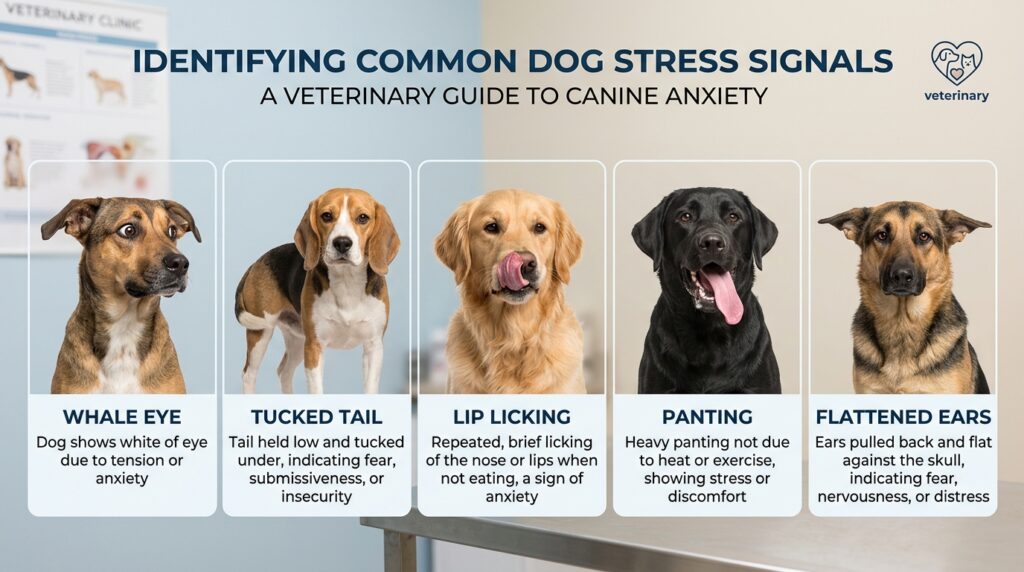
Dogs communicate anxiety through body language before it ever becomes destructive behaviour. Most owners miss the early signals.
Mild stress signals:
- Lip licking when nothing edible is nearby
- Yawning outside of sleepy contexts
- Turning the head or body away from something
- Avoiding eye contact
Moderate dog stress signals:
- Ears pulled back flat
- Panting without heat or exercise as a cause
- Refusing treats they’d normally eat eagerly (a big one)
- Furrowed brow, fidgeting, can’t settle
Severe signs:
- Whites of the eyes showing (sometimes called “whale eye”)
- Tail tucked tightly
- Trembling
- Growling, showing teeth, or snapping
- Dilated pupils
Behavioural signs that show up at home:
- Destructive chewing, especially near exits
- House soiling despite being toilet trained
- Barking or howling when left alone
- Pacing, spinning, or other repetitive behaviour
- Drooling excessively
- Sudden loss of appetite
- Regression in training a dog that seems to have “forgotten” what they knew
If your dog is doing several of these things, something is wrong. The question is what.
Why is my dog scared of everything? Common causes
Separation anxiety
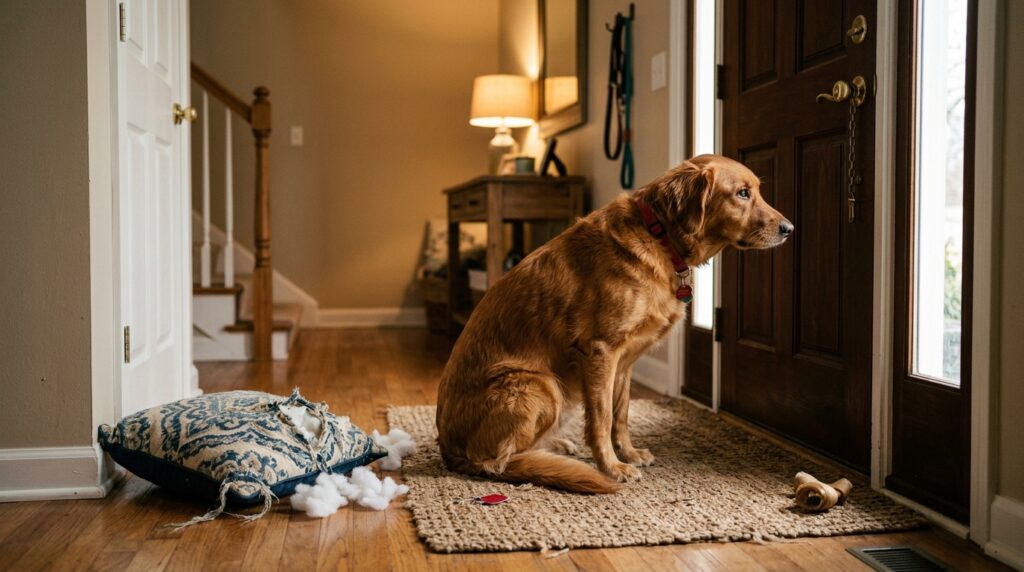
The dog panics when left alone. Signs include howling, barking, destructive behaviour near windows or doors, and house soiling specifically when the owner is absent.
Dogs with separation anxiety often start showing stress before you leave. They clock the routine: keys picked up, shoes on, bag grabbed. By the time you actually open the door, they’re already in distress.
Separation anxiety affects roughly 1 in 6 dogs and is one of the most common reasons dogs are surrendered to shelters.
Sound sensitivity
Some dogs are genuinely frightened of specific sounds thunder, fireworks, construction noise, vacuum cleaners, even certain phone ringtones. A dog that doesn’t recover quickly from an unexpected loud noise and stays distressed for 30 minutes afterward has sound sensitivity, not just a normal startle reflex.
Territorial or social anxiety
The dog is fine in neutral territory but reactive around their own home, yard, or with strangers approaching. Lunging, barking, and stiffness along fence lines are the classic signs.
Medical causes
This one gets missed constantly. Pain, dental disease, neurological issues, gastrointestinal discomfort, and cognitive dysfunction in senior dogs can all cause anxiety-like behaviour. A dog that suddenly starts acting weird, especially if they’re older or if there’s been no obvious change in environment needs a vet check before anything else. (Source: Cornell University College of Veterinary Medicine)
Cognitive dysfunction syndrome (CDS)
Senior dogs sometimes develop CDS, the canine equivalent of dementia. Pacing at night, disorientation, restlessness, and confusion are the hallmarks. It’s not anxiety in the traditional sense, but it looks very similar from the outside.
Under-socialisation
Puppies that weren’t exposed to different people, sounds, environments, and animals between 3 and 12 weeks of age often grow into fearful adult dogs. The window for easy socialisation is narrow. Missing it doesn’t doom a dog, but it does make anxiety more likely later on.
When should you be worried?
See a vet soon (not “eventually”) if:
- Anxiety symptoms came on suddenly in a previously calm dog
- Your dog is losing weight or refusing food consistently
- The behaviour is getting worse week over week
- You’re seeing signs of physical pain alongside the anxiety
- Your dog has snapped or bitten someone
- Anxiety is affecting daily quality of life for both you and the dog
- The dog is a senior and showing nighttime restlessness or disorientation
Any sudden behaviour change in an adult dog without an obvious environmental cause is a medical question first.
What you can do at home
Build a predictable routine
Predictability is genuinely one of the most powerful tools for an anxious dog. Same walk time, same feeding time, same bedtime routine. When a dog knows what’s coming next, the world feels less threatening.
Dr. Katherine Houpt, Professor Emeritus of Behaviour Medicine at Cornell’s College of Veterinary Medicine, puts it simply: if the dog does X, then Y happens. Consistent cause-and-effect reduces uncertainty, and uncertainty is a large part of what anxious dogs struggle with.
Even small rituals help. Asking your dog to sit before the lead goes on. A hand touch before you open the door. Simple, repeatable interactions that give the dog something predictable to do.
Crate training
A crate is a safe space, not a punishment. Dogs that are properly crate trained often retreat to their crate voluntarily when stressed. A covered crate in a quiet corner of the house can be a genuine refuge during thunderstorms, fireworks, or when visitors arrive.
The key is introducing it gradually and positively, never using it as punishment, and making sure the dog has positive associations with it before you need it for a stressful situation.
Calm arrivals and departures
Coming home to an anxious dog and immediately making it a big emotional reunion actually reinforces the idea that your absence was stressful. Low-key arrivals and low-key departures help more than dramatic greetings. Ignore the dog for 2 minutes when you get home, then greet them calmly. It takes getting used to, but it makes a real difference for dogs with separation anxiety.
Exercise and mental enrichment
A tired dog is a calmer dog. Daily exercise appropriate for the breed and age matters. So does mental enrichment: puzzle feeders, sniff games, short training sessions, enrichment toys. 15 minutes of active mental work can take the edge off anxiety better than an extra walk for some dogs.
Create an escape plan for triggers
If your dog reacts to strangers on walks, have a plan before you need it. Teach a “look at me” cue or a hand touch so you can redirect their attention when a trigger appears. Cross the street early. Don’t wait until the dog is already fixated.
Home remedies for dog anxiety: what’s worth trying
Calming pheromone diffusers and sprays
Products like Adaptil use synthetic versions of the calming pheromone nursing mothers produce. They’re not a cure, but for mild situational anxiety a vet visit, a car ride, fireworks night, they take the edge off for many dogs. They work best when combined with training, not used alone.
Pressure wraps
The ThunderShirt and similar products apply gentle constant pressure, similar to swaddling. About 80% of dog owners in studies reported some improvement in anxiety symptoms with pressure wraps. They’re most effective for situational anxiety like storms or fireworks, not chronic anxiety. (Source: American Kennel Club)
Calming supplements
Alpha-casozepine (found in products like Zylkene) is a milk protein with mild calming effects. L-theanine and melatonin are also used. These aren’t medications, they’re supplements with moderate evidence behind them and very low side-effect profiles.
For situational stress like travelling or boarding, starting a supplement 1–2 days before the event can help. For ongoing anxiety, the evidence is less strong, and prescription options may be more appropriate.
Always run any supplement past your vet first, especially if your dog takes any regular medication.
What you should avoid
- Don’t punish anxious behaviour. A dog that’s growling is communicating. Punishing the growl removes the warning signal, it doesn’t remove the anxiety, and it often creates a dog that bites without warning.
- Don’t flood your dog with the thing they’re scared of. Forcing a noise-sensitive dog to sit through fireworks without any management plan makes things worse, not better.
- Don’t assume Benadryl will calm your dog. It causes mild sedation in some dogs and hyperactivity in others. It doesn’t address anxiety at all.
- Don’t use shock collars or punishment-based methods on an anxious dog. There’s strong evidence these approaches worsen anxiety and increase aggression risk.
- Don’t skip the vet visit if symptoms came on suddenly. Treating behavioural anxiety when the real cause is physical pain wastes time and doesn’t help the dog.
Dog anxiety medication: what vets actually prescribe
When training and management strategies aren’t enough or when the anxiety is severe enough that the dog can’t learn in that state, medication genuinely helps.
Daily medications (for ongoing anxiety):
- Fluoxetine (Reconcile): An SSRI similar to Prozac. Works gradually over 4–6 weeks. Effective for separation anxiety and generalised fear.
- Clomipramine (Clomicalm): A tricyclic antidepressant. Also used for separation anxiety. Takes several weeks to reach full effect.
Situational medications (for specific events):
- Trazodone: Used before known stressful events vet visits, grooming, travel, fireworks. Takes effect within a few hours.
- Dexmedetomidine (Sileo): An oromucosal gel applied to the gums. Specifically approved for noise aversion in dogs. Works within 30–60 minutes.
Medication works best alongside behaviour modification not instead of it. A dog on fluoxetine still needs training and routine. The medication reduces the anxiety enough that the dog can actually learn, which is the point.
Ask your vet specifically about options. The right calming medication for your dog depends on the type of anxiety, their health history, their weight, and their other medications.
Training an anxious dog: the basics
Behaviour modification for anxiety takes weeks to months. There’s no shortcut. But the approach matters enormously.
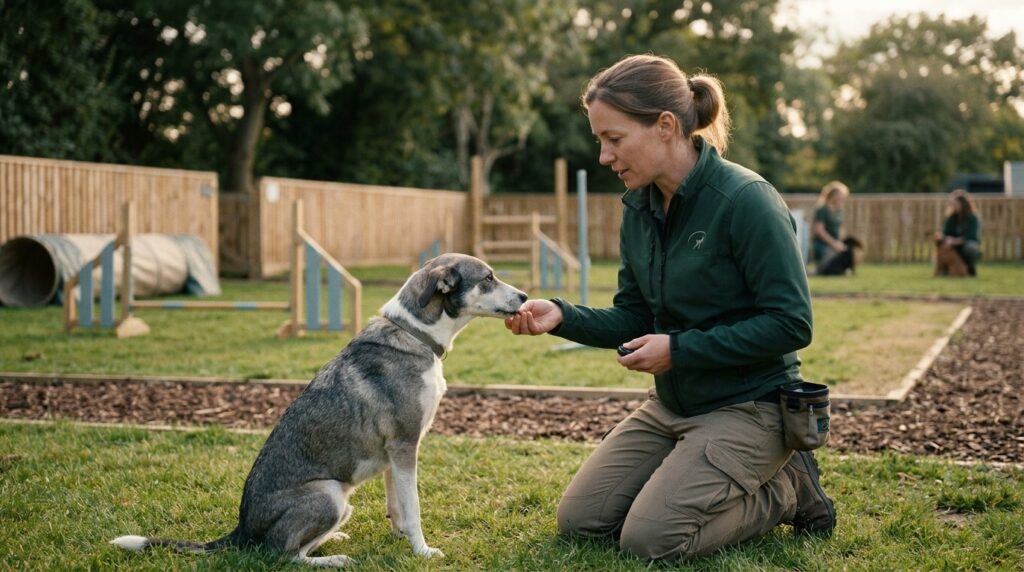
Desensitisation: Gradually exposing the dog to the trigger at a level so low it doesn’t provoke a reaction, then slowly increasing intensity over time. For a thunder-sensitive dog, this might start with barely audible thunder sounds played at a distance while the dog eats their favourite food.
Counter-conditioning: Pairing the scary thing with something the dog loves high-value treats, a favourite toy, so the emotional association starts to shift. “Stranger approaching” starts to predict “chicken breast.” The fear response weakens over time.
Positive reinforcement only. Fear-based training methods make anxious dogs worse. Full stop.
Look for a certified professional dog trainer (CPDT-KA) or a veterinary behaviourist (DACVB) if the anxiety is significant. Behavioural issues that are serious enough to cause physical symptoms or safety concerns really do need professional guidance, not just YouTube videos.
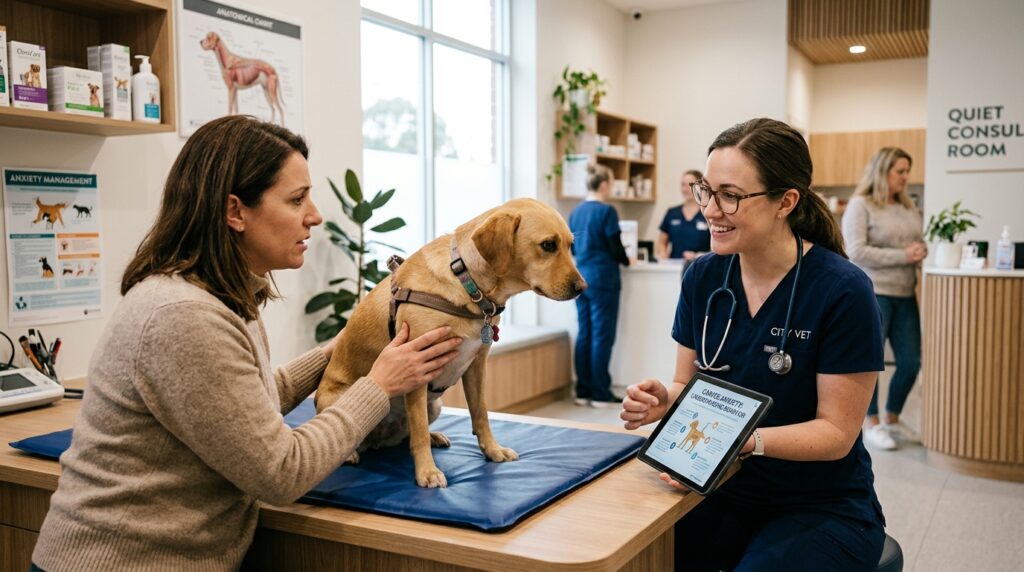
When to visit a veterinarian
Book a vet visit if:
- You’re seeing any of the severe anxiety signs listed above
- The behaviour started suddenly in an adult dog
- Your dog is a senior showing nighttime restlessness, pacing, or confusion
- Home strategies haven’t made a dent after 3–4 weeks
- You want to discuss prescription dog anxiety medication
- You’re not sure whether what you’re seeing is anxiety, pain, or something else
A vet can also refer you to a board-certified veterinary behaviourist for complex cases. If your dog has bitten someone or is showing aggression alongside anxiety, this is the right level of professional help.
Real-life scenario
A 4-year-old rescue Greyhound started showing signs of separation anxiety 3 months after adoption. The owners came home to destroyed cushions, urine in the hallway, and a dog that paced frantically for the first 10 minutes after they returned.
The vet ruled out medical causes. They were referred to a certified dog trainer who created a desensitisation plan for departures and alone time. The dog was also started on trazodone for a 4-week period to reduce anxiety enough to learn.
Six weeks in, the destructive behaviour had stopped. By 3 months, the dog could be left alone for 4 hours without distress. The trazodone was gradually reduced and eventually stopped.
Training alone would have worked eventually. The medication made the training work faster, because the dog was calm enough to actually process what was being taught.
Frequently asked questions
What can I give my dog for anxiety at home? For mild situational anxiety, pheromone diffusers, calming supplements (like Zylkene or L-theanine), and pressure wraps are the safest starting points. For anything beyond mild or situational anxiety, talk to your vet before trying anything new.
Why is my dog acting weird all of a sudden? Sudden behaviour changes in dogs, especially adults with no history of anxiety — are often medical. Pain, neurological issues, hormonal changes, and cognitive decline can all look like anxiety. A vet check is the right first step.
How do I stop my dog from crying when left alone? Crate training, a consistent departure routine, and gradual alone-time training are the foundations. For dogs with true separation anxiety, these need to be paired with a desensitisation programme and sometimes medication. Avoid prolonged emotional goodbyes.
How to calm a dog down during fireworks or thunder? A covered crate in a quiet interior room, white noise or calming music, and a pheromone diffuser help. For dogs with severe noise sensitivity, ask your vet about Sileo (dexmedetomidine), it’s specifically designed for this and works well when given 30–60 minutes before the event.
What’s the 3-3-3 rule for dog anxiety? It’s a guideline for newly adopted dogs: 3 days to decompress, 3 weeks to learn routine, 3 months to feel settled. It’s a useful framework but not a precise rule, some dogs take longer, and some need additional support throughout.
Read more on thepetblueprint.com
- [Can I give my dog Benadryl? Dosage, safety, and what vets actually say — thepetblueprint.com]
- [Dog bite levels explained: what a level 3 or level 4 bite really means — thepetblueprint.com]
- [Best family dogs: which breeds handle chaos, kids, and real life — thepetblueprint.com]
The short version
Anxious dogs need three things: a correct diagnosis, a consistent routine, and an appropriate treatment plan, whether that’s training, medication, supplements, or all three.
The first thing to rule out is always a physical cause. Pain looks like anxiety. CDS looks like anxiety. Don’t treat the behaviour until you know what’s driving it.
And if your dog is genuinely suffering losing weight, can’t settle, showing fear every day, medication isn’t a last resort. It’s a reasonable tool that makes everything else work better.
Start with your vet. Build from there.
- Cornell University College of Veterinary Medicine — vet.cornell.edu
- American Kennel Club — akc.org
- ASPCA Animal Behaviour — aspca.org
- PetMD Veterinary Review — petmd.com
- American Veterinary Medical Association (AVMA) — avma.org