

 By
By Disclaimer: This content is for informational purposes only and does not replace professional veterinary advice. If your dog shows signs of illness after eating cat food, consult a licensed veterinarian promptly.
Table of Contents
Your dog just inhaled your cat’s dinner. Now what?
It happens in about 4 seconds flat. You turn around, and your dog has their entire face in the cat bowl. The cat is watching from across the room looking personally offended.
So now you’re wondering: is this a problem? Do I need to call the vet? Is my dog going to be sick tonight?
The short answer: probably not, if it was just one incident. But there’s more to it than that. Cat food and dog food look similar, but they’re built for completely different animals. And what’s fine once can become a real health problem if it becomes a habit.
Here’s exactly what you need to know.
Quick answer: can dogs eat cat food?
Yes, a small amount of cat food is unlikely to harm a healthy adult dog. But cat food is not suitable as a regular diet for dogs. It’s significantly higher in protein and fat than dog food, and it’s formulated for an animal with entirely different nutritional needs.
One stolen mouthful? Monitor and move on. A dog eating cat food daily for weeks? That’s a problem worth fixing.
Why cat food and dog food are actually very different
This is the part most people skip, and it matters.
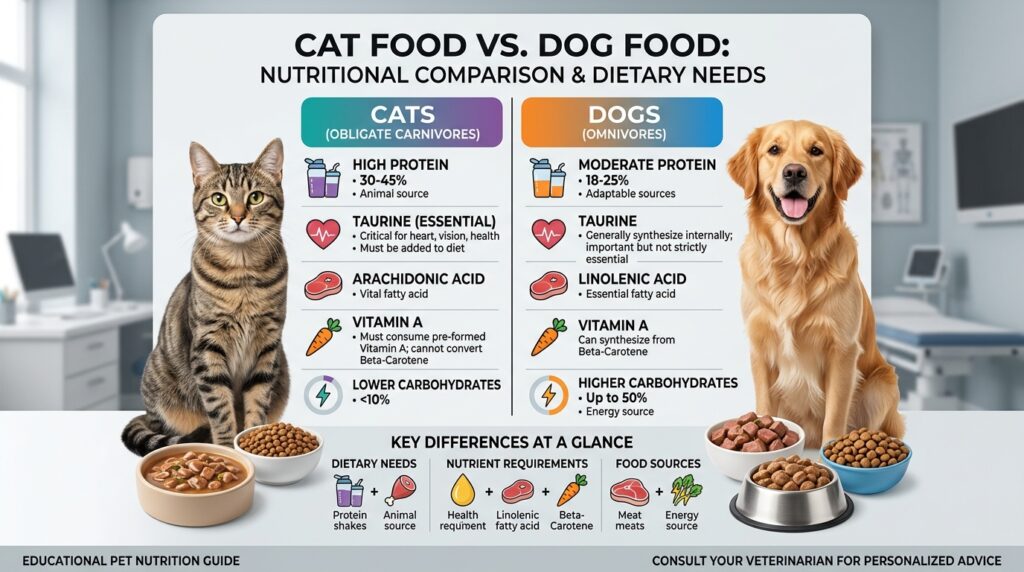
Dogs are omnivores. They can get everything they need from a mix of animal protein, carbohydrates, and plant-based ingredients. Cats are obligate carnivores, they biologically require meat-based nutrition to survive and can’t thrive on plant-based sources the way dogs can.
Because of this, cat food is formulated to be dramatically richer than dog food.
Here’s what the Association of American Feed Control Officials (AAFCO) sets as minimum standards for adult dogs vs. adult cats: (Source: AAFCO Nutrient Profiles)
| Nutrient | AAFCO minimum for adult dogs | AAFCO minimum for adult cats |
|---|---|---|
| Protein | 18% | 26% |
| Fat | 5.5% | 9% |
| Taurine | Not required | 0.1% (dry), 0.2% (wet) |
| Arachidonic acid | Not required | 0.02% |
Cat food also contains higher levels of vitamin A and different mineral ratios. These aren’t dangerous to dogs in a single serving, but they add up over time.
The result: cat food is richer, denser, and more calorie-heavy than anything a dog’s digestive system is designed to process regularly.
Is it bad for dogs to eat cat food? The real risks
Pancreatitis
This is the biggest concern. The pancreas produces enzymes to break down fat. When a dog eats significantly more fat than usual like a large bowl of cat food, the pancreas can become inflamed.
Pancreatitis ranges from mild (vomiting, loose stools, lethargy for a day or two) to severe (hospitalisation, IV fluids, serious complications). Dogs with a history of pancreatitis, or small breeds that are more prone to it, are at higher risk from even a single large serving of cat food.
Digestive upset
Even without pancreatitis, the extra protein and fat in cat food is harder for a dog’s digestive system to process. Vomiting and diarrhea within a few hours of eating cat food are the most common outcomes when a dog has eaten a significant amount.
Weight gain
Cat food has more calories per gram than dog food. A dog that snacks on cat food regularly will take in more calories than their food calculations account for. Over months, that becomes visible weight gain and all the joint, heart, and metabolic problems that come with it.
Nutritional imbalance
Long-term, a dog eating large amounts of cat food gets too much protein and fat, not enough fibre, and the wrong balance of vitamins and minerals. Excess vitamin A accumulates in the body over time. Chronic nutritional imbalance affects bone health, organ function, and metabolism.
Picky eating
This one is underrated. A dog that gets regular access to cat food which smells stronger and tastes richer, often starts refusing their own food. That feeding battle is genuinely hard to reverse once it’s established.
Is cat food bad for dogs in all situations?
No. Context matters.
A single incident: One stolen serving of cat food is unlikely to harm a healthy adult dog. Monitor for vomiting or diarrhea and move on.
Emergency situations: If you’ve completely run out of dog food, a small amount of cat food for a day is fine. It’s not ideal, but it won’t cause lasting harm. Switch back to dog food as soon as possible.
Vet-supervised recovery: In rare cases, vets may recommend high-calorie cat food short-term for a dog that needs extra calories during illness recovery. This is a specific clinical situation, not a general recommendation. If this comes up, it should be guided entirely by your vet. Puppy food is usually a better alternative in these cases, it’s calorie-dense and nutritionally balanced for dogs.
As an occasional treat: A bite or two of cat food isn’t dangerous for a healthy dog. The issue is when occasional becomes frequent.
Is dog food bad for cats? (Since you probably have both)
The reverse question gets asked just as often.
Cat food eaten by a dog: probably fine in small amounts. Dog food eaten by a cat: actually more problematic.
Cats cannot synthesise taurine, arachidonic acid, or sufficient vitamin A from plant sources, they must get these from animal-based food. Dog food doesn’t contain adequate levels of taurine or arachidonic acid for cats. A cat that eats dog food regularly can develop serious deficiencies over time, including dilated cardiomyopathy (a heart condition linked to taurine deficiency) and vision problems.
If you have both species at home, keeping their food separate isn’t just a preference, it’s genuinely important for your cat’s health. (Source: ASPCA Animal Nutrition)
Can puppies eat cat food?
This comes up a lot. Puppies need specific calcium-to-phosphorus ratios to support healthy bone development. Cat food doesn’t provide these in the right balance for a growing dog.
Is cat food bad for puppies? More so than for adults. Puppies are in a critical growth phase. Nutritional imbalances during this period have longer-lasting effects than the same imbalance in an adult dog. Keep cat food away from puppies entirely, and make sure they’re on a large or medium-breed puppy formula appropriate for their size.
Can a dog die from eating cat food?
Direct death from a single serving of cat food is extremely unlikely for a healthy adult dog.
That said, severe pancreatitis, which can be triggered by a large, rich meal is a serious condition that can be life-threatening without treatment. A dog that eats an entire can or large bowl of high-fat cat food and develops pancreatitis needs veterinary care.
Long-term, chronic feeding of cat food contributes to conditions (obesity, pancreatitis, organ strain) that do shorten a dog’s life. So the accurate answer is: one incident is almost certainly fine, but repeated exposure carries real cumulative risk.
When should you be concerned?
Call your vet if your dog shows any of these after eating cat food:
- Vomiting more than once or twice
- Diarrhea that lasts more than 24 hours
- Abdominal pain (hunched posture, whining when touched around the belly)
- Bloating or distended stomach
- Complete refusal to eat for more than a day
- Lethargy that’s out of character
- Rapid or laboured breathing
Take your dog to an emergency vet the same day if the vomiting is severe, your dog seems to be in significant pain, or they’re showing signs of collapse. These can indicate pancreatitis progressing beyond mild.
Puppies, senior dogs, and dogs with existing health conditions (kidney disease, liver disease, pancreatitis history) should be evaluated sooner rather than later after any significant cat food ingestion.
What you can do at home
If your dog just ate cat food:
- Stay calm. One incident is unlikely to be dangerous.
- Check how much they ate. A bite or two is very different from finishing the cat’s entire bowl.
- Provide fresh water. Cat food is richer and denser than dog food; your dog will likely be thirstier than usual.
- Skip the next meal if they ate a large amount. Give their digestive system a few hours to recover before resuming normal feeding.
- Monitor for the next 12–24 hours. Vomiting or loose stools that resolve quickly are usually fine. Symptoms that persist or worsen need a vet.
- Go back to normal dog food as soon as the next meal.
What you should avoid
- Don’t panic over a single small incident, for a healthy adult dog, it’s almost always fine
- Don’t let it become a habit just because your dog seems to love it
- Don’t use cat food as a long-term appetite stimulant for a picky dog, there are dog-specific solutions for that
- Don’t ignore repeated vomiting, even if it seems mild
- Don’t assume cat food is fine because it’s “still meat-based”, the nutritional ratios are the problem, not the ingredients
- Don’t let cats eat dog food regularly either, it’s a genuine health risk for cats
How to stop your dog from eating the cat’s food
In multi-pet households, this is a logistics problem as much as a training one.
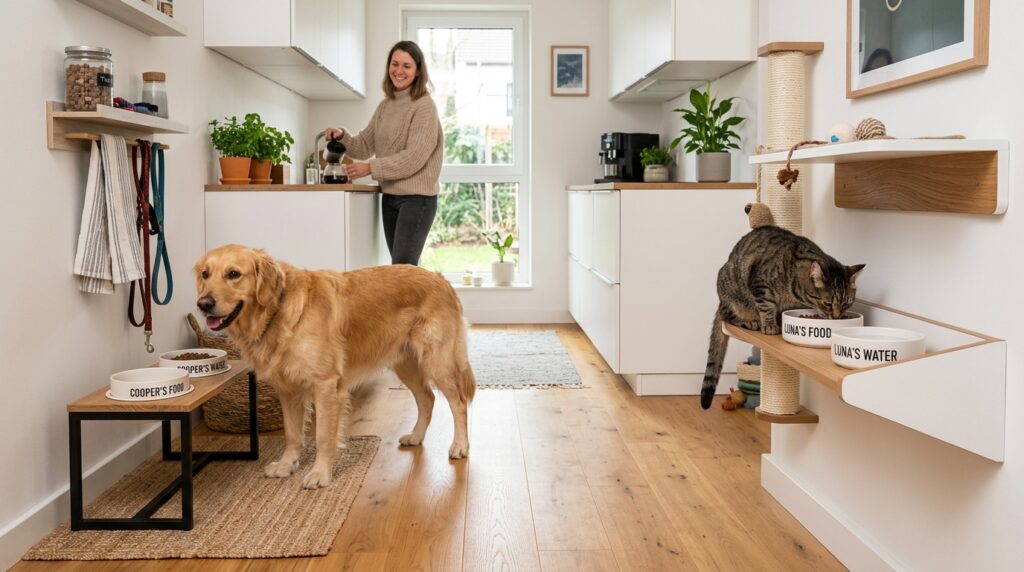
Separate feeding areas: The easiest fix. Feed your cat in a room your dog can’t access. A door with a cat-sized gap using a door prop works well for size differences. Electronic cat doors that only open for the cat wearing the correct tag work for dogs and cats of similar size.
Elevated feeding stations: Cats are natural climbers. If your dog can’t jump or isn’t allowed on furniture, feeding your cat on a counter or tall cat tree keeps the bowl completely out of reach.
Microchip-activated feeders: These only open for the pet with the correct microchip or RFID tag. Expensive upfront but solves the problem permanently.
Timed feeding for your cat: If your cat free-feeds (food available all day), switch to timed meals. Put the food down for 20–30 minutes, then pick it up. Nothing left out means nothing for the dog to steal.
“Leave it” training: Teaching a solid “leave it” cue gives you a reliable way to redirect your dog when they approach the cat bowl. It takes a few weeks of consistent training but is genuinely useful beyond just the cat food situation.
When to visit a veterinarian
Book a vet appointment if:
- Your dog has been eating cat food regularly and you want their weight and blood values checked
- You have a dog with a history of pancreatitis, even one incident of cat food eating warrants a call
- Your dog refuses to eat dog food and you suspect the cat food habit has created a picky eater
- Any of the warning symptoms above persist for more than 24 hours
- Your puppy has been getting into cat food consistently
Real-life scenario
A Beagle named Finn lived with two cats. His owner worked from home and didn’t notice for several weeks that Finn was finishing the cats’ leftovers every morning after they walked away from the bowl. It wasn’t a dramatic amount each day, maybe a third of a bowl.
After about 6 weeks, Finn had gained 1.5 kg. He’d also started refusing his own food unless it was mixed with something more flavourful. A vet check confirmed the weight gain was the only issue, no pancreatitis, no organ changes. But reversing the picky eating habit took 3 weeks of consistent feeding structure and removing access to the cat food entirely.
The vet noted that small amounts daily are more insidious than one large incident, precisely because the effects build slowly and owners often don’t notice until the habit is entrenched.
Frequently asked questions
Can dogs eat wet cat food, or is dry safer? Both wet and dry cat food are higher in protein and fat than dog food. Wet cat food is more calorie-dense and has a stronger smell that dogs find particularly appealing, which makes overconsumption more likely. Neither is safer than the other in terms of nutritional impact, they’re both unsuitable as regular dog food.
Can I mix a bit of cat food into dog food to make it more appealing? Occasionally, a very small amount mixed in is unlikely to cause harm. But doing it regularly to solve a picky eating problem usually makes the problem worse, the dog becomes progressively less interested in plain dog food. Address picky eating with your vet rather than with cat food as a long-term workaround.
Is it ok for dogs to eat cat food in an emergency? Yes. A small amount for a day or two while you get more dog food is fine for a healthy adult dog. Keep the portion small and switch back as soon as possible.
Can a cat eat dog food if they run out of cat food? Occasionally, yes, a meal of dog food won’t harm a cat. But cats need taurine, arachidonic acid, and vitamin A at levels dog food doesn’t provide. A cat eating dog food regularly over weeks will develop deficiencies that affect their heart and vision. It’s a bigger concern for cats than cat food is for dogs.
Should dogs eat cat food to gain weight? Only under veterinary supervision. If your dog needs to gain weight, your vet will likely recommend puppy food or a high-calorie recovery diet formulated for dogs, not cat food. These provide the extra calories your dog needs without the nutritional imbalances that come with cat food.
Read more on thepetblueprint.com
- [Fresh dog food vs kibble: which one is actually better for your dog — thepetblueprint.com]
- [What’s really inside your dog’s food: how to read a pet food label — thepetblueprint.com]
- [Can dogs eat bananas? Yes, but here’s exactly how much to give — thepetblueprint.com]
The short version
One incident of cat food? Almost certainly fine. Monitor, hydrate, skip the next meal if they ate a lot, and go back to normal.
Regular cat food eating? Worth stopping. The protein and fat load causes weight gain, increases pancreatitis risk, and can turn your dog into a picky eater that won’t touch their own food.
The fix is simple: separate feeding areas, timed meals for your cat, and consistent access control. It takes a few days to set up and saves a lot of vet visits.
Sources:
- AAFCO Nutrient Profiles — aafco.org
- ASPCA Animal Nutrition — aspca.org
- American Kennel Club — akc.org
- Merck Veterinary Manual — merckvetmanual.com



![[Fresh dog food vs kibble: which one is actually better for your dog — thepetblueprint.com]](https://thepetblueprint.com/wp-content/uploads/2026/04/Fresh-Dog-Food-vs-Kibble-Which-Is-Better-for-Your-Dog.png)
1 Comment