
 By
By Disclaimer: This content is for informational purposes only and does not replace professional veterinary advice. Always consult a licensed veterinarian for your dog’s health, nutrition, and care needs.
Table of Contents
You’re thinking about a German Shepherd. Or you already have one and realised you have questions.
Either way, you’re in the right place.
German Shepherds are one of the most popular dog breeds in the world and one of the most misunderstood. People bring them home expecting a loyal, trainable companion and then discover they’ve got 80 pounds of nervous energy that needs 2 hours of exercise a day and will chew through a sofa if bored.
They’re extraordinary dogs. But they’re not easy dogs. And knowing what you’re actually getting into makes the difference between a brilliant relationship and a stressful one.
This guide covers everything that matters: lifespan, types, health risks, training, grooming, and what actually changes in the first year.
Quick answer: how long do German Shepherds live?
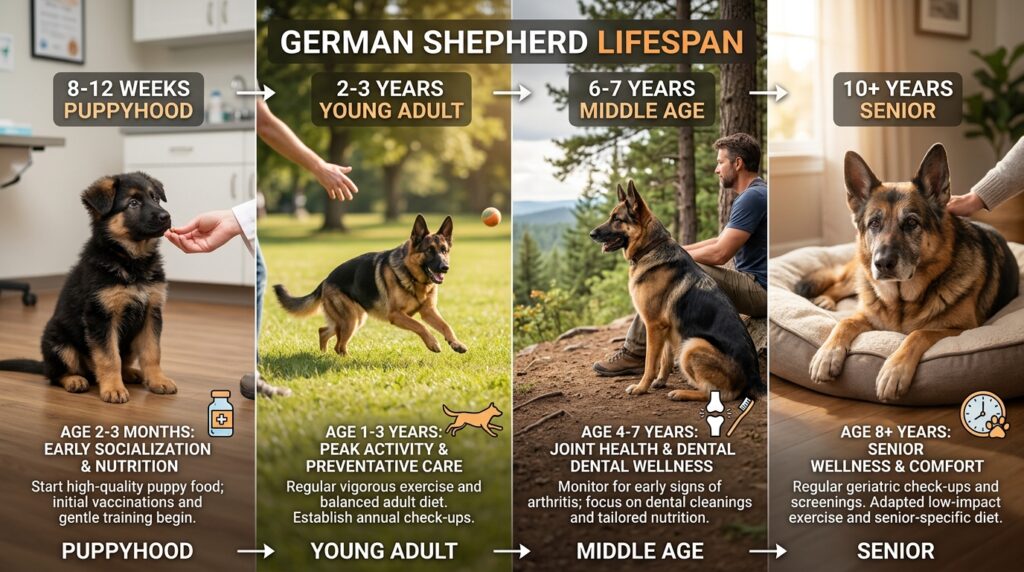
The average German Shepherd lifespan is 7–10 years. Some reach 12–13 years with excellent genetics, good nutrition, and regular veterinary care. The alsatian life expectancy (Alsatian is simply the British name for the same breed) is identical.
Larger dogs generally live shorter lives than smaller breeds, and German Shepherds follow that pattern. Hip dysplasia, cancer, and degenerative myelopathy are the conditions most likely to shorten their lives. More on all of these below.
Types of German Shepherds
Most people don’t realise there are several distinct types within the breed. They’re all German Shepherds, but they look and behave differently enough to matter when you’re choosing one.
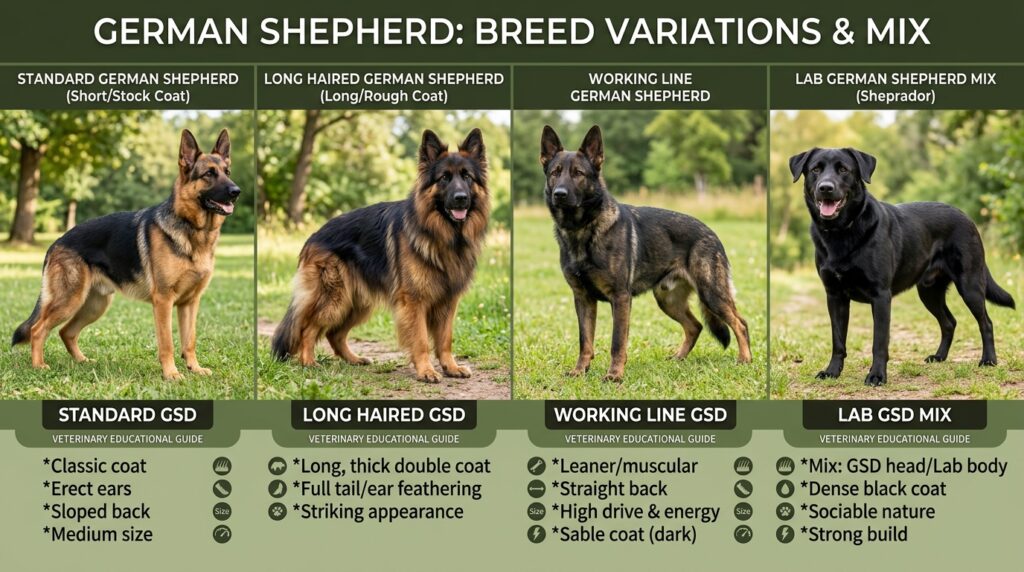
Standard (stock coat) German Shepherd
The most common type. Medium-length double coat, classic black and tan or black and red colouring. This is the working-line and show-line dog most people picture.
Long-haired German Shepherd
Same breed, different coat length. Long-haired German Shepherds have a softer, flowing coat without the dense undercoat of the standard version. They shed slightly less in terms of loose fur but need more regular brushing to prevent matting. Personality is identical to the standard type.
Some registries don’t recognise the long coat as a show standard, but as a companion dog, the long-haired German Shepherd is increasingly popular and genuinely striking.
Working line vs. show line
Working-line German Shepherds (bred for police, military, and protection work) tend to have higher drive, more intensity, and less tolerance for inactivity. Show lines are generally calmer temperamentally and have the more sloped back that’s become associated with the breed visually.
If you’re a first-time owner, a show-line dog from a reputable breeder is usually a better fit than a working-line dog. Working lines need a job. Literally.
Miniature German Shepherd (mini German Shepherd)
This is almost always a mix, not a true breed. A miniature German Shepherd is typically a cross between a German Shepherd and a smaller breed Border Collie, Poodle, or Yorkshire Terrier are common. There’s no officially recognised miniature version of the breed.
Some breeders market them as “miniature German Shepherds” but this is a marketing term, not a breed classification. If you want a smaller dog with similar traits, research the specific mix rather than assuming it’s a smaller version of the standard breed.
Mix breed German Shepherd
German Shepherd mixes are common and often make excellent pets. The most popular include:
Lab German Shepherd mix (Sheprador): Combines the Labrador’s easy-going nature with the Shepherd’s intelligence and loyalty. Usually 50–80 lbs. Generally easier for first-time owners than a purebred German Shepherd.
German Shepherd Husky mix (Gerberian Shepsky): High energy, striking appearance. Needs significant exercise. Not recommended for apartment living.
German Shepherd Poodle mix (Shepadoodle): Lower shedding than a purebred Shepherd. More manageable energy in many cases. Good option for families with mild allergies.
With any mix, the temperament and health outcomes depend on both parent breeds. Research both sides.
German Shepherd size: what to expect
Males stand 24–26 inches tall and weigh 65–90 lbs. Females are smaller at 22–24 inches and 50–70 lbs.
German Shepherd puppies grow fast. Most reach their adult height by 12 months, but they continue filling out in muscle and weight until 18–24 months. Don’t rush this process overfeeding a large-breed puppy to encourage faster growth increases the risk of joint problems later.
German Shepherd health issues: the honest picture
German Shepherds are prone to several conditions that owners should understand before buying or adopting.
Hip and elbow dysplasia
This is the biggest health concern for the breed. Around 20% of German Shepherds develop hip dysplasia, according to the Canine Health Information Center. It’s a malformation of the hip joint that causes pain and eventually arthritis. (Source: Canine Health Information Center — caninehealthinfo.org)
Signs include limping, difficulty getting up, reduced range of motion, and reluctance to climb stairs or jump. It’s managed with weight control, joint supplements, anti-inflammatory medications, and in some cases surgery.
Ask any breeder for OFA (Orthopedic Foundation for Animals) hip scores on both parents before buying a puppy. This is non-negotiable. A responsible breeder will have them.
Degenerative myelopathy (DM)
DM is a progressive neurological disease that affects the spinal cord, gradually causing paralysis of the hind legs. German Shepherds have a genetic predisposition to it.
Early signs are subtle: slight wobbling in the back end, dragging of the rear feet, weakness when climbing. There’s no cure, but physical therapy slows progression. DNA testing can identify carriers.
Bloat and gastric dilation-volvulus (GDV)
GDV is a life-threatening emergency. The stomach fills with gas (bloat), then twists on itself. It’s most common in large, deep-chested breeds including German Shepherds.
Signs are: distended abdomen, retching without bringing anything up, restlessness, and collapse. If you see these signs, go to an emergency vet immediately. GDV can kill a dog within hours.
To reduce risk: feed 2 smaller meals daily rather than one large one, don’t exercise for an hour before or after eating, and consider a preventive gastropexy procedure (stomach tacking) during spay or neuter surgery.
Exocrine pancreatic insufficiency (EPI)
EPI happens when the pancreas stops producing digestive enzymes properly. The dog can’t absorb nutrients from food, leading to weight loss despite a ravenous appetite, chronic diarrhea, and a rough coat.
It’s manageable with lifelong enzyme supplementation mixed into food. Dogs with properly managed EPI can live normal, healthy lives.
Cancer
German Shepherds have a higher-than-average cancer rate. Hemangiosarcoma (a tumour in blood-rich organs like the spleen and heart), bone cancer, and intestinal cancers are the most common types. Regular vet check-ups become especially important from middle age onward.
Eye conditions
Pannus (chronic superficial keratitis) is a progressive eye condition more common in German Shepherds, particularly those at high altitudes or with significant UV exposure. It causes inflammation of the cornea and can lead to blindness if untreated. It’s manageable with eye drops when caught early.
German Shepherd lifespan: factors that make the biggest difference
Beyond genetics, 4 things have the most impact on how long a German Shepherd lives:
Weight management. Overweight German Shepherds put more stress on already-vulnerable joints and organs. Keeping your dog lean is one of the highest-impact things you can do for their longevity.
Exercise. Regular, appropriate exercise maintains muscle mass that supports joints, reduces weight-related health risks, and supports cardiovascular health.
Annual vet check-ups. German Shepherds benefit from regular wellness exams, especially from age 5 onward. Early detection of hip problems, heart changes, and early cancer signs makes a real difference in outcomes.
Breeder selection. A puppy from health-tested parents with OFA hip scores and DM genetic testing at minimum, starts life with meaningfully better odds than a puppy from untested stock.
The German Shepherd expected lifespan of 7–10 years is an average. Dogs with excellent genetics, healthy weight, and consistent vet care regularly exceed it.
The first year with a German Shepherd puppy
Weeks 1–4: settling in
Bring your puppy home at 8 weeks. Set up a crate, a designated feeding area, and a safe space before they arrive not after. The first few days are about building positive associations with you, the crate, and the house routine. Keep things calm. Limit visitors.
Start house training immediately. Consistent schedule: outside after every meal, after every sleep, and every 2 hours when awake. Reward every success.
Months 2–4: socialisation window
Between 8 and 16 weeks is the critical socialisation period. Expose your puppy to different people, environments, sounds, surfaces, and other animals positively, not forcefully. Missing this window doesn’t ruin a dog, but it does make confidence-building harder later.
Enrol in a puppy class. German Shepherds need to learn how to behave around other dogs, and puppy classes give that in a controlled setting.
Months 4–6: teething and training
Teething hits hard around 3–6 months. Provide appropriate chew toys and redirect immediately when they go for furniture or shoes. Chewing is normal; chewing your chair leg is not, and consistent redirection from day one saves you significant frustration.
Continue basic obedience training daily. 10–15 minute sessions are enough at this age. Sit, stay, come, leave it, and loose-leash walking are the foundations. German Shepherds pick these up fast, the issue is usually consistency on the owner’s side, not capability on the dog’s.
Months 6–12: adolescence
German Shepherds hit adolescence around 6 months. They test limits, lose focus, and occasionally seem to forget everything they learned. This is normal and temporary.
Don’t back down on training. Don’t stop exercising. The dogs that become difficult adult German Shepherds are almost always dogs whose training and structure lapsed during adolescence.
Exercise at this stage: 45–60 minutes daily is appropriate. Avoid high-impact jumping and rough play on hard surfaces until growth plates close around 12–18 months.
Feeding a German Shepherd
German Shepherd puppies need large-breed puppy food, not standard puppy food. Large-breed formulas have controlled calcium and phosphorus levels that support healthy joint development without forcing too-rapid bone growth.
Feed puppies 3 times daily until 6 months, then twice daily. Adults eat twice daily.
Always choose an AAFCO-compliant food. The nutritional adequacy statement on the bag tells you it meets established standards for your dog’s life stage.
Switch from puppy food to adult food at 12–18 months. Your vet can confirm the right timing based on your specific dog’s development.
For bloat prevention: use a slow-feeder bowl, don’t free-feed, and keep two 60-minute exercise gaps around mealtimes.
Grooming a German Shepherd
German Shepherds shed. A lot. Year-round, with two heavier shedding periods in spring and autumn.
Brushing: Daily brushing with a pin brush or slicker brush makes the biggest difference. It takes 10 minutes and dramatically reduces the hair that ends up on your floors and furniture. During shedding season, add an undercoat rake.
Bathing: 3–4 times a year is enough. More frequent bathing strips the natural oils that protect the coat and skin. During shedding periods, a bath followed by thorough blow-drying helps release the dead undercoat faster.
Long-haired German Shepherds need extra attention to areas that mat: behind the ears, around the collar, and under the armpits. Check these weekly.
Nails: Trim monthly, or more frequently if they’re not wearing down naturally through exercise. Overgrown nails affect gait and put strain on joints.
Ears: Check weekly for redness, odour, or debris. Clean only when needed with a vet-recommended ear cleaner. Over-cleaning causes more problems than it prevents.
What you should avoid
- Don’t skip socialisation during the puppy window, it’s much harder to reverse fear than to prevent it
- Don’t use punishment-based training on a German Shepherd; it creates anxiety and can increase aggression
- Don’t buy from a breeder without OFA hip scores on both parents
- Don’t allow high-impact jumping or stairs until the growth plates close (around 12–18 months)
- Don’t exercise for 60 minutes before or after meals, bloat risk is real in this breed
- Don’t expect a working-line German Shepherd to be calm without 2+ hours of daily structured activity
When to visit a veterinarian
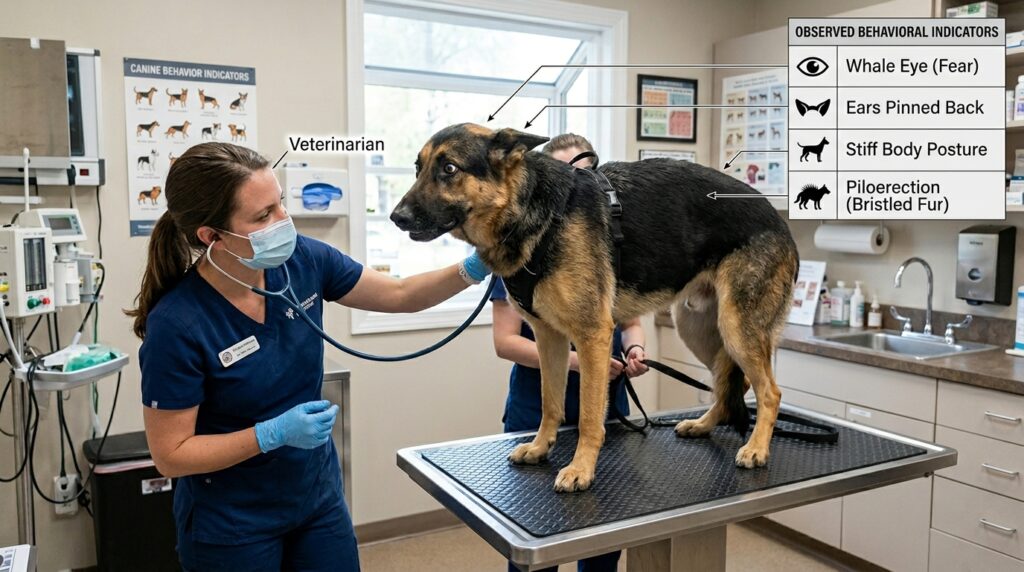
Book a vet visit if you notice:
- Limping or difficulty getting up, especially in the rear end
- Sudden weight loss despite normal or increased appetite
- Retching without vomiting, distended abdomen, or restlessness after eating (emergency, go immediately)
- Changes in eyes: cloudiness, redness, or vision problems
- Chronic loose stools or diarrhea
- Any lump or swelling, especially in a dog over 5 years old
Routine annual exams are important for this breed from day one. From age 5 onward, twice-yearly check-ups are worth considering given the breed’s health profile.
Real-life scenario
A couple brought home a 9-week-old German Shepherd puppy from a breeder who had no health testing records. By 18 months, the dog was showing early signs of hip discomfort mild stiffness after lying down, occasional reluctance to jump into the car.
X-rays confirmed moderate hip dysplasia in both hips. The dog was managed with joint supplements, weight kept at the lower end of the healthy range, and modified exercise (swimming instead of high-impact running). He lived comfortably to age 9.
The vet noted that the outcome could have been better with a puppy from health-tested parents, and significantly worse if the signs had been ignored or the dog had been allowed to become overweight.
The health testing conversation with a breeder is uncomfortable. It’s worth having anyway.
Frequently asked questions
How long do Alsatians live? Alsatian is the British term for the German Shepherd. The lifespan is the same: 7–10 years on average, with some reaching 12+ years with good genetics and care.
Is there a miniature German Shepherd breed? No officially recognised miniature version exists. “Mini German Shepherds” sold by breeders are almost always crosses with smaller breeds. Research the specific mix before buying.
What is a lab German Shepherd mix like as a pet? Generally calmer and more adaptable than a purebred German Shepherd. The Labrador’s easy temperament balances the Shepherd’s intensity. Good for families, usually easier for first-time owners.
Are long-haired German Shepherds different in personality? No. The coat length is a genetic variation, not a personality trait. Long-haired German Shepherds have the same temperament as standard-coated ones.
How much does a German Shepherd cost? From a reputable, health-testing breeder: $2,000–$4,000 in the US. Rescue organisations and shelters regularly have German Shepherds and mixes available for significantly lower adoption fees.
Read more on thepetblueprint.com
- [Best family dogs: which breeds actually handle kids and real life — thepetblueprint.com]
- [Dog anxiety: why your dog is scared and what actually helps — thepetblueprint.com]
- [What’s really inside your dog’s food: how to read a pet food label — thepetblueprint.com]
The short version
German Shepherds live 7–10 years on average. The biggest factors affecting that: hip health (get a puppy from tested parents), weight management throughout life, and consistent veterinary care.
They’re extraordinary dogs. Loyal, intelligent, trainable, and deeply bonded to their families. They’re also high-maintenance in terms of exercise, training, grooming, and health monitoring.
Go in with clear expectations and you’ll find one of the most rewarding dog breeds there is.
- Canine Health Information Center — caninehealthinfo.org
- American Kennel Club — akc.org
- ASPCA Dog Care — aspca.org
- Merck Veterinary Manual — merckvetmanual.com
- OFA (Orthopedic Foundation for Animals) — ofa.org